Quick answer: Make a hand you can repeat, add useful Chips and Mult, level the hand you actually play, and read the next Boss Blind before spending or skipping.

On this page
Balatro beginner guide: build something repeatable
Start with a poker hand you can assemble regularly, then buy Jokers that improve how it scores. Planet cards level their named hand types, so use them for the hands your deck actually produces. Keep enough money for a useful next purchase and read the coming Boss Blind before changing the build. Your first goal is a working loop that reaches each score target, not a rare combination that only exists in a screenshot.
Balatro is a deck-building roguelite with poker-shaped hands and game-changing Jokers. This guide uses the official overview and identified community mechanics references. Practical priorities are editorial; no personal run, measured win rate, or fixed best opening is claimed. Decks, stakes, boss rules, and available cards can change the correct decision. Learn the reason behind an upgrade so you can adapt when the shop offers something different.
| Decision | What to check | Useful first habit |
|---|---|---|
| Playing a hand | Recognized hand and scoring cards | Choose reliable cards |
| Buying a Joker | Its trigger and scoring role | Support the current loop |
| Using a Planet | The hand it levels | Improve a repeated hand |
| Spending in the shop | Immediate need and remaining budget | Avoid unrelated purchases |
| Next Boss Blind | Its exact restriction | Prepare before selecting it |
1. Read the recognized hand before playing
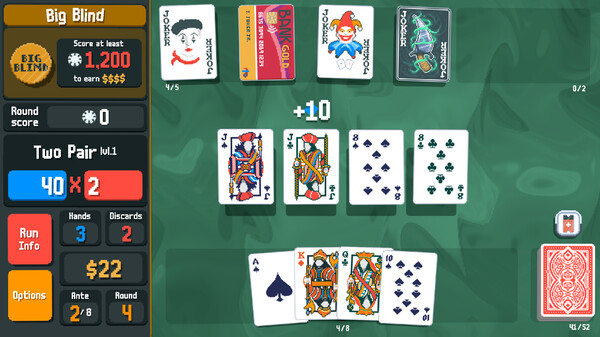
The game scores a recognized poker hand using Chips and Mult, with effects from cards and Jokers contributing to that calculation. Open Run Info when you need to review hand types and their levels. A hand can contain extra played cards that are not part of the scoring combination. The distinction matters because an effect triggered when a card is scored does not necessarily trigger on every card you placed on the table.
Higher-ranked hand classifications take precedence over lower ones regardless of how heavily the lower hand was leveled. You cannot always play a larger combination and ask it to score as your preferred upgraded smaller one. Check the displayed hand name before confirming. For example, a run built around Pair needs a genuine recognized Pair if a Joker specifically requires that hand, rather than merely a higher hand that includes matching ranks. Read whether an effect says contains or is.
2. Use discards to build a realistic target
Choose a hand you can form from the cards currently available, then discard unwanted cards with that purpose in mind. A reliable Pair or Two Pair can be a better practical starting point than repeatedly spending every discard chasing an unlikely Straight Flush. Inspect the ranks and suits you are keeping and the remaining deck, rather than deciding only from the highest possible hand on the reference chart.
The best target can change when a Joker, deck effect, or card modification makes a different hand easier to produce. Be willing to adapt without abandoning a working plan for every new offer. Red Deck starts with an additional discard each round, while Blue Deck offers an additional played hand once unlocked. Those are different resources. A discard reshapes what you may draw; a played hand also uses the round’s opportunities and can trigger effects related to playing.
3. Give each Joker a job in the build
Jokers occupy dedicated slots rather than entering the ordinary playing-card deck. Their effects can supply Chips, additive Mult, multiplicative Mult, economy, retriggers, or other changes. Read both the effect and its condition. A powerful conditional Joker may do little if the required hand, card type, or action rarely occurs in your run. The usual starting capacity is five Joker slots, with exceptions created by particular effects and decks.
Treat the slots as a limited plan. You may need immediate scoring, a source of growth, and enough economic support to keep improving later. An unrelated Joker is not automatically useful because a slot is empty, and a rare label does not prove it is better for this run. Before buying, explain what the new card adds and which action will trigger it. If you cannot name that action, check whether it actually solves the next Blind’s problem.
4. Distinguish added Mult from multiplied Mult
An effect giving extra Mult adds to the current multiplier; an X-Mult effect multiplies it. Their usefulness therefore depends on the scoring state and trigger. As a simple arithmetic illustration, adding ten to a Mult value of twenty produces thirty, while multiplying twenty by two produces forty. That example explains the operations, not the order or full result of every possible Balatro effect chain.
Chips remain the other part of the score. A build that grows one side while neglecting the other can miss a target despite an impressive-looking Joker. Read the actual score sequence and notice which side needs help. Retriggers and card enhancements create additional interactions, but you do not need to master every advanced chain before the first win. Begin with clear unconditional or reliably triggered effects, then add complexity when you understand what each step contributes.

5. Level a hand you can actually produce
Planet cards increase the base Chips and Mult of their associated poker hand. Mercury levels Pair, Uranus levels Two Pair, Jupiter levels Flush, and Saturn levels Straight. Using a Planet does not alter your deck’s ranks or suits to make that hand appear more often. It improves the score base when the relevant hand is recognized. Consistency and hand level are related goals with different tools.
Check your recent hands before spending heavily on a Planet. If the run regularly plays Pairs, additional Pair levels can support the actual loop. A large nominal upgrade to a difficult hand is less useful when you rarely draw it. Other effects can also change hand levels, and the Run Info screen lets you inspect the current state. Keep the decision tied to your available cards and Jokers rather than assuming the most prestigious poker hand must always be the correct investment.
6. Make the shop solve the next problem
The Shop appears after defeating a Blind. Its ordinary offerings include cards, booster packs, and a voucher, with special changes possible through other effects. Before buying, identify the immediate weakness: missing score, an unreliable target hand, limited resources, or a specific upcoming boss restriction. Compare the offered purchase with that problem. Several inexpensive unrelated items can leave the run with less useful improvement than one well-chosen card.
Rerolls can provide new options but also consume money. Use them for a purpose rather than repeatedly searching for one famous Joker without a backup plan. Booster packs and direct cards offer different choices, so inspect what is actually being purchased. A voucher’s attractive long-term description does not remove the need to survive the current target. Keep enough budget flexibility that the next useful offer remains affordable instead of spending every dollar because it is currently available.
7. Read the Boss Blind before committing
Each Ante contains a Small Blind, Big Blind, and Boss Blind. Small and Big Blinds can be skipped for tags, while the Boss must be played. Bosses can debuff cards, hide information, or restrict what hands count. Those rules can interrupt a build that looked comfortable against the earlier score targets. Read the next boss and ask whether your main action still works under its condition.
Skipping can trade away a round and its normal progression opportunities for a tag. Do not skip by default merely because the target looks easy or the tag appears exciting. Some effects trigger when a Blind is selected and will not trigger when it is skipped. A growing Joker or a need for the next shop can make playing useful. Choose a skip when its reward supports a clear plan and you can still prepare for the mandatory Boss Blind.
Review a run by the decision that failed
If a run ends, identify whether the problem was low score, an unreliable hand, a neglected boss rule, or spending that left no useful upgrade. Those problems have different answers. A better scoring Joker does not repair a hand you cannot draw, and another Planet does not remove a boss restriction. Change one priority on the next attempt so you can recognize what improves.
Beginner questions
Do I need to know real poker to start?
The in-game hand list explains the combinations you need. Balatro’s Jokers, levels, and modified cards then create its own scoring decisions. Learn the displayed classifications and triggers rather than relying only on a familiar poker ranking.
Are rare Jokers always better?
No. A Joker’s condition and role need to fit the current cards and available actions. A common effect that triggers reliably can help more than a rare effect you never activate. Judge what it adds to this build.
Should I chase a Straight Flush every round?
Only if your deck and effects make it practical. A repeatable smaller hand with suitable levels and Jokers can be a stronger plan than using all available resources on a rare draw. Check consistency and the next target together.
Sources and scope
Sources read November 11, 2026. Mechanics come from the linked official overview and identified community references. Practical advice is editorial. No personal playtest, search-volume measurement, traffic result, or CMS score is claimed.