Quick answer: Combine Jokers that reward the same repeatable action, then check their activation stage and order. A shared trigger matters more than a rare label or a famous pair.

On this page
Balatro Joker synergies: connect triggers before buying
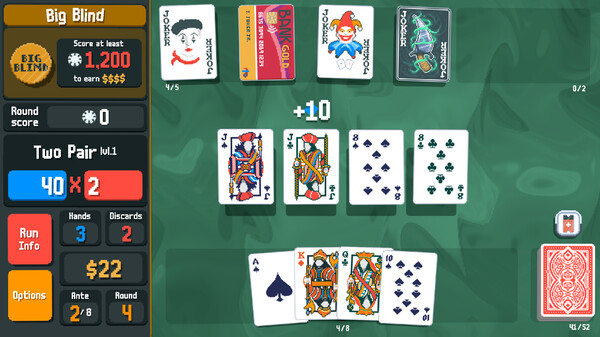
A useful synergy joins effects around an action your deck can perform repeatedly. Supernova and Card Sharp reward repeated hand types on different timescales. Photograph and Hanging Chad connect a first-face-card effect with a first-scored-card retrigger. Egg and Swashbuckler turn sell-value growth into Mult. Blueprint adds a copy of a compatible neighboring effect. Each loop has a condition you need to preserve.
This guide uses the retrieved individual Joker pages and activation-sequence reference. It gives editorial build advice, not a claim of firsthand testing or a measured best combination. Availability, boss rules, stakes, and the current deck can change the result. The goal is to explain why pieces work together and what stops them working, so you can adapt to the offers you actually receive.
| Loop | Pieces | Condition to preserve |
|---|---|---|
| Repeated hand | Supernova + Card Sharp | Same hand, with a repeat in this round |
| Few discards | Green Joker with a reliable hand | Playing grows it; discarding reduces it |
| Face-card retrigger | Photograph + Hanging Chad | First scored card must be a face card |
| Sell-value growth | Egg + Swashbuckler | Keep the valuable Joker owned |
| Flexible copy | Blueprint + compatible target | Target is immediately to its right |
1. Supernova and Card Sharp: use different repeat counters
Supernova adds Mult based on how often the recognized scoring hand has been played during the run. Card Sharp gives X3 Mult when that hand has already been played in the current round. Together they can support a hand type you assemble consistently: the long-term count increases Supernova’s contribution while a same-round repeat meets Card Sharp’s separate condition.
The distinction matters. Playing Pair many times across earlier rounds does not activate Card Sharp on the first Pair of a fresh round. You still need a repeat within that round. Conversely, Supernova’s run count is retroactive when the Joker is acquired, according to its reference. Build around the exact recognized hand name and inspect the number of remaining plays. A higher-ranked hand that merely contains the same cards may be recognized differently, which can break the intended repetition.
2. Green Joker: pair growth with a reliable hand
Green Joker gains additive Mult as hands are played and loses it when cards are discarded. It works naturally with a deck that can play a reliable hand without frequently spending discards to find it. The useful synergy is partly between the Joker and your habits: a small repeatable hand can preserve growth better than an ambitious hand that demands repeated reshuffling through discards.
This is not an instruction to avoid every necessary discard. Losing a little growth can be preferable to failing a Blind because the current hand cannot score enough. Inspect the actual tradeoff. Some game effects can also cause discards, so the growth condition is not solely a matter of your own discard button. Read the upcoming boss and keep a viable damage base. A scaling Joker needs time and successful rounds; it cannot automatically rescue a run that already lacks immediate score.
3. Photograph and Hanging Chad: position the first scorer
Photograph gives X2 Mult when the first played face card is scored, and retriggering that card can activate the effect again. Hanging Chad retriggers the first card used in scoring two additional times. Their overlap requires the first scored card to be a face card. Put the relevant scoring face card in the correct played-card position and confirm it belongs to the recognized hand.
The drawback is dependence on that card actually scoring and remaining active. A played face card that does not belong to the scoring combination is not enough, and a boss debuff can suppress the intended triggers. Hanging Chad’s unlock also requires beating a Boss Blind with a High Card hand, so it may not be available on a fresh collection. The pairing’s mechanism is documented, but this article does not promise a fixed final score across every hand, enhancement, edition, or boss condition.
4. Egg and Swashbuckler: keep value in the collection
Egg grows its sell value over rounds, while Swashbuckler adds the sell value of all other owned Jokers to Mult. Keeping an increasingly valuable Egg therefore provides a growing contribution to Swashbuckler without selling it. The effect is based on sell value, not simply the original purchase price. Read the current figures rather than assuming all Jokers contribute equally.
The tradeoff is slot capacity and immediate utility. Egg does not directly provide Chips or Mult on its own, and the pair uses space that might otherwise hold immediate scoring tools. Selling Egg converts its value to money but removes that owned-value contribution from Swashbuckler. Decide which result the run currently needs. Swashbuckler itself has an unlock condition, and its current effect includes all other owned Jokers; do not copy an older left-only arrangement from an outdated description.

5. Blueprint: copy a compatible neighboring effect
Blueprint copies the ability of the Joker immediately to its right. It can strengthen a useful scoring or retrigger effect, but compatibility is part of the rule. Read the tooltip and place the intended target beside it. A powerful Joker elsewhere in the row is not automatically the one being copied, and buying Blueprint does not mean every passive or end-of-round effect becomes available in duplicate.
The reference explicitly excludes several kinds of effects and notes that Egg’s sell-value growth cannot be copied. It also distinguishes copying a scoring result from copying how a scaling Joker grows. Move the target deliberately when your needs change, then inspect the active neighboring relationship before playing. Blueprint is unlocked after a run win, so treat it as a collection-dependent tool rather than a required starting purchase. Its flexibility is useful only when the actual selected target contributes to this build.
6. Constellation: connect Planet use with another growth axis
Constellation gains X0.1 Mult when a Planet card is used and starts at X1. That can connect your ordinary hand-leveling plan with a separate multiplicative scaling effect. The Planet improves its associated hand’s base, while the Joker grows from the use event. Choose useful hand upgrades where possible so the purchase develops both the main loop and the scaling effect.
Black Hole is a Spectral card despite sometimes appearing in a Celestial pack. The Constellation reference says it does not grow the Joker. That is a useful example of why the card category matters more than the pack’s color or theme. Do not spend on unrelated Planets solely for scaling if the immediate run needs a direct scoring fix. The right choice depends on how much time and money remain to develop the effect before the next difficult target.
Arrange effects by their activation stage
Played scoring cards activate from left to right, and independent Joker scoring also uses a left-to-right sequence. Within the same activation stage, putting additive Mult before multiplicative Mult can improve the result. That is a more precise rule than placing every X-Mult Joker at the far right and expecting it to multiply every earlier or later effect in the whole hand sequence.
Some effects trigger during card scoring, some on held cards, and some after the playing cards finish. Examine the stage as well as the visual row order. The Photograph and Chad example depends on the first scored card, while Blueprint depends on its adjacent Joker. Read the actual animation and descriptions when a expected result fails. A changed boss condition, non-scoring card, incompatible copy, or wrong counter can explain the problem without making the documented combination incorrect.
Questions about Joker combinations
Should every X-Mult effect go at the end?
Use activation stages. Additive-before-multiplicative order matters within the relevant stage, but card effects and independent Joker effects do not all activate at the same time. Neighbor-based copying also has its own placement requirement.
Why did Card Sharp not activate after many earlier Pairs?
It needs the recognized hand to have been played already in this round. Supernova instead uses the count across the run. Those counters complement each other but are not interchangeable.
Can Blueprint copy any valuable Joker?
No. Check compatibility and the immediate right-hand target. Passive effects, certain end-of-round effects, and other listed exclusions cannot be assumed copyable. Copying a useful permitted effect is different from duplicating a Joker’s entire behavior.
Sources and scope
Sources read November 11, 2026. Mechanics come from the identified community references. Practical advice is editorial. No personal playtest, search-volume measurement, traffic result, or CMS score is claimed.
- Jokers mechanics reference
- Guide: Activation Sequence mechanics reference
- Green Joker mechanics reference
- Supernova mechanics reference
- Card Sharp mechanics reference
- Photograph mechanics reference
- Hanging Chad mechanics reference
- Egg mechanics reference
- Swashbuckler mechanics reference
- Blueprint mechanics reference
- Constellation mechanics reference
Sources and further reading
- Jokers mechanics reference
- Guide: Activation Sequence mechanics reference
- Green Joker mechanics reference
- Supernova mechanics reference
- Card Sharp mechanics reference
- Photograph mechanics reference
- Hanging Chad mechanics reference
- Egg mechanics reference
- Swashbuckler mechanics reference
- Blueprint mechanics reference
- Constellation mechanics reference