Quick answer: Pick Deep Rock Galactic if you want pure cooperative PvE where the only thing that can ruin a run is the cave, and failure costs you a few minutes. Pick Hunt: Showdown 1896 if you want a PvPvE extraction shooter where other players are the real threat, the bounty can be stolen, and dying means losing the hunter you brought in. They are both squad shooters, but one is a cooperative job and the other is a wager.
These two games get compared because they both involve small teams, both punish carelessness, and both have a reputation for being better with friends. That comparison stops being useful very quickly. One is built so that a group of strangers can succeed together; the other is built so that another group of strangers can take everything you earned. The right choice depends far more on what kind of tension you want than on which game is better made.
What is the core difference between the two games?
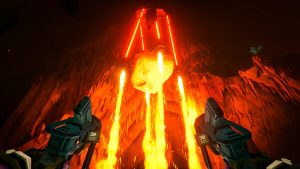
Deep Rock Galactic is a cooperative first-person shooter about mining. Up to four players drop into a procedurally generated cave, complete an objective, and extract. Everything that opposes you is generated by the game: the terrain, the swarms, the hazards. No other player will ever shoot at you.
Hunt: Showdown 1896 is a PvPvE extraction shooter. You and a small team enter a map, hunt a boss and its AI enemies, and try to leave with the bounty. Other teams are doing the same thing on the same map, and they can hear you, track you, ambush you and take the bounty you were carrying.
That single structural difference drives everything else: pacing, stakes, how long a session lasts, how much a mistake costs, and even how you talk to your teammates. Deep Rock is a game about execution against a system. Hunt is a game about reading other people.
Which game is easier to start playing?
Deep Rock Galactic is dramatically friendlier to new players, and it is designed that way on purpose.
The onboarding is generous. You can play solo with a drone companion, you can join random groups without anyone expecting much, and the difficulty scales across a range of hazard levels that you choose yourself. If a mission goes badly, you lose time rather than progress. The community norm is to help newer players rather than punish them, which matters more than any tutorial.
Hunt: Showdown 1896 is hostile in the specific way competitive extraction games are hostile. The tutorial teaches the controls and almost nothing about the decisions that matter. Your first several matches will end with you dying to someone you never saw, and the game will not explain what you did wrong. Learning requires reading, watching, or a patient friend.
The honest framing is that Deep Rock is easy to start and hard to master, while Hunt is hard to start and hard to master. If you have limited patience for being bad at something in public, that difference should decide the question.
How long does a match actually take?
Both games ask for a real sitting rather than a quick round, but the shape of that time is different.
A Deep Rock mission has a defined objective and a clear end. You drop in, you work, you call the drop pod, you leave. If everything goes well it is a compact session; if the cave is unkind it stretches. There is no possibility of another team extending it, so the upper bound is set by your own competence.
A Hunt match has no fixed length because it is contested. You might extract early with a bounty and be done quickly, or you might spend a long time stalking a compound while two other teams do the same, or you might die in the first two minutes. The variance is the point, and it means you cannot plan a Hunt session as tightly as a Deep Rock one.
That unpredictability is either the best thing about Hunt or the worst, depending entirely on whether you enjoy not knowing how the next half hour will go.
How punishing is death in each game?
This is where the two games diverge most sharply, and it is the factor most likely to determine which one you actually keep playing.
| Dimension | Deep Rock Galactic | Hunt: Showdown 1896 |
|---|---|---|
| Core mode | Cooperative PvE, no player enemies | PvPvE extraction, other teams contest the objective |
| Match length | Defined by the mission objective and your own pace | Contested and variable, set by other teams as much as by you |
| Team size | Small squad, playable solo with a drone companion | Small squad or solo, queued against other teams of similar size |
| Onboarding difficulty | Gentle, with selectable hazard levels and helpful norms | Steep, with little explanation and frequent unseen deaths |
| Progression | Per-class levels and promotions, plus weapon overclocks | Account rank, unlocks, and hunters that level and can be lost |
| Cost of dying | Lost time on the mission, then you try again | Lost equipment, lost hunter progress, and a lost bounty |
| Tension source | The cave, the swarm, and the extraction timer | Other players, sound discipline, and the risk of being ambushed |
| Best for | Players who want teamwork without losing to strangers | Players who want stakes and the thrill of a contested extraction |
The table row that matters most is the cost of dying. In Deep Rock, a wipe is an inconvenience and a story. In Hunt, a death can erase a hunter you have invested in, along with the gear you equipped, which is why the same mistake feels completely different in each game.
Which one has the better progression system?
They are solving different problems, so neither is better in the abstract.
Deep Rock progression is horizontal and generous. Each class levels separately, promotions open up more content, and weapon overclocks change how a weapon behaves rather than simply increasing a number. Cosmetics arrive through assignments and a free season track. The result is that playing more gives you more options without making you strictly stronger than a newer player.
Hunt progression is vertical and tense. Your account rank unlocks weapons and tools, individual hunters level up and gain traits, and losing a hunter means starting that hunter again. The equipment you bring is a real investment, and choosing to bring good gear is a decision with consequences.
If you like the feeling of a collection growing, Deep Rock is more satisfying. If you like the feeling that your choices have weight because they can be taken from you, Hunt delivers something Deep Rock deliberately avoids.
Do you need friends to enjoy either game?
No, but the experience differs enough that it is worth knowing before you buy.
Deep Rock is genuinely playable solo because of the drone companion that compensates for the missing teammates, and it is genuinely playable with random groups because the objective is shared and there is no incentive to betray anyone. A quiet solo run and a chaotic four-player run are both complete experiences.
Hunt is playable solo and has a specific tension that group play lacks, but it is a much harsher teacher alone. With a team, communication carries you: one player hears something, another covers the angle, and the group survives mistakes that would kill a solo player. Random teammates are a lottery, and silence is a real disadvantage.
The practical recommendation is that Deep Rock is the safer purchase for someone who mostly plays alone or with strangers, and Hunt rewards a regular group far more.
Which should you buy?
Choose Deep Rock Galactic if you want a cooperative game you can drop into after work, where the worst outcome is a funny disaster, where progression is generous, and where you never have to worry about another player ruining your session. It is one of the most reliably enjoyable co-op shooters available, and it respects your time.
Choose Hunt: Showdown 1896 if you want tension as the main course. If the idea of creeping through a compound because you heard a branch snap, knowing another team is doing the same, sounds exciting rather than stressful, Hunt does that better than almost anything else. It also demands patience, sound discipline, and a tolerance for losing things you worked for.
If you are genuinely torn, start with Deep Rock. It is cheaper emotionally, it teaches squad shooting without punishing you for learning, and it will tell you quickly whether you enjoy the cooperative format. Hunt is easier to appreciate once you already know you like slow, tense, high stakes matches.
Frequently asked questions
Are the two games similar enough to compare directly?
Only at the surface level of small-team shooters. One is PvE and the other is PvPvE, and that difference changes the pacing, the stakes and the community around each game.
Which game is better for a group of three?
Both support small squads well. Deep Rock is the easier recommendation for a casual group because a bad night is still productive, while Hunt turns a bad night into a series of losses.
Is Hunt: Showdown 1896 pay to win?
Progression unlocks equipment through play rather than purchase, and the tension comes from risk rather than from stat advantages. The 1896 version is an update to the existing game rather than a separate product.
Can you play Deep Rock Galactic competitively?
Not against other players. Its challenge comes from higher hazard levels and optional harder mission types, which raise the difficulty of the same cooperative format rather than introducing opponents.
Which has more content?
Both have substantial content, and comparing raw volume is misleading because the content types differ. Deep Rock adds procedural missions and seasonal assignments; Hunt adds maps, bosses and equipment over time. Judge by which loop you want to repeat, not by a count.
One is a job you do with friends and the other is a gamble you take with friends. Decide which of those sounds like a good evening, and the choice makes itself.