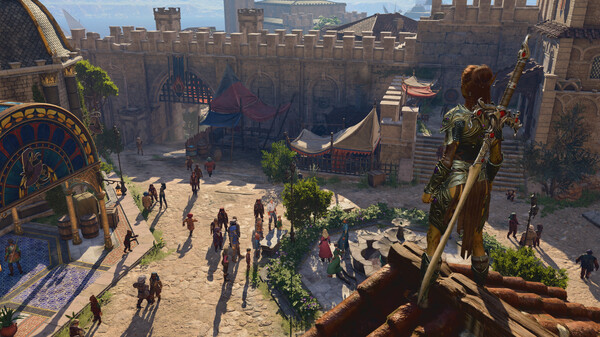
TL;DR: The best couch co op games on PS5 for your room are Sackboy: A Big Adventure for group platforming, Split Fiction for a two-person action story, Overcooked! All You Can Eat for kitchen teamwork, Baldur’s Gate 3 for a long shared RPG, LEGO Star Wars: The Skywalker Saga for exploring familiar films, and Moving Out 2 for short chaotic jobs.
Start with Sackboy or Moving Out 2 when three or four people are sharing the TV. Start with Split Fiction when exactly two people want a campaign designed around them. Choose Baldur’s Gate 3 only if your pair wants to learn an RPG and keep returning to the same save.

On this page
How to choose a PS5 couch game that fits the room
This list prioritizes supported same-console cooperation, meaningful work for each player and differences in learning demand. The recommendations use official developer and PlayStation pages; they are editorial choices, not a personal-playtest ranking or a hardware performance comparison. Every pick has a reason to choose it and a reason it might disappoint your group.
Local multiplayer and online multiplayer have different limits. A product page saying “up to four online players” does not mean four people can sit at one PS5. Baldur’s Gate 3 is the clearest example here: its local split-screen limit is two, while the online party can contain four people.
| Game | Players on one PS5 | Online option | Best fit |
|---|---|---|---|
| Sackboy: A Big Adventure | 2–4 | Up to 4 | Group platforming |
| Split Fiction | 2 | 2 with crossplay and Friend’s Pass | A committed action pair |
| Overcooked! All You Can Eat | 2–4 | Up to 4 with crossplay | Coordinating under pressure |
| Baldur’s Gate 3 | 2 split-screen | Up to 4; crossplay after Patch 8 | A long shared RPG |
| LEGO Star Wars: The Skywalker Saga | 2 split-screen | No native online co-op | Relaxed Star Wars exploration |
| Moving Out 2 | 2–4 | Up to 4 with crossplay | Short shared jobs |
A shared screen keeps everyone looking at the same scene; split-screen gives each person a separate view. Neither format is automatically better. Shared-screen platforming can require staying together, while split-screen divides the visible area and makes text smaller. Consider your TV size and seating distance before committing to a long game full of menus.
1. Sackboy: A Big Adventure: best for a mixed group
Sackboy is the strongest general starting point here for up to four local players who want to run, jump and finish levels together. PlayStation lists one to four local players and describes the game as a multiplayer platforming adventure. The cooperative goal is easy to understand even when the group does not have equal skill.
Its appeal is a sequence of distinct courses rather than a complicated campaign-management system. A group can work on one level, make another attempt or stop after a natural checkpoint in the evening. This suits friends who want a shared activity without spending the first session choosing character statistics and reading an inventory.
Platforming still asks for timing and spatial judgment. Let the least experienced person practice movement before rushing through a section. If one person cares about collecting everything while another only wants to reach the exit, agree on the current goal. That conversation matters more than an arbitrary claim that the game is universally easy.
The drawback is that a shared platforming scene can make the slower player feel hurried. Choose it when your group is willing to stay together and retry. It also supports online play, but the couch recommendation uses separate local controllers on one PS5. If a PC friend wants to join remotely, confirm the exact current platform compatibility rather than assuming the PC edition connects to PlayStation.
2. Split Fiction: best for two players who want equal campaign roles
Split Fiction is built specifically around two players. Mio and Zoe move between science-fiction and fantasy settings with changing mechanics, and the adventure asks both people to coordinate. It is a clear choice for a pair who wants to work through something written around cooperation rather than share an optional side mode.
Local split-screen lets both people play on the PS5, and online play provides another route if the pair cannot meet. EA documents Friend’s Pass for an owner’s invited partner and crossplay across supported PlayStation, Xbox, PC and Nintendo Switch 2 releases. The original Switch is a different platform and is not included in that statement.
The changing abilities make it useful for players who enjoy learning together. One chapter’s solution may require a different kind of timing or coordination from the next. Give each other a chance to understand the new input before assuming the partner is falling behind. Both people need patience when a section requires another attempt.
The downside is that variety also produces a learning demand. A non-gamer who has just become comfortable with one action can be asked to learn another. Choose Split Fiction if both people actively want an action campaign and can tolerate retries. If your evening is intended to be low-pressure conversation with a controller in hand, LEGO exploration or an assisted party job is a gentler starting point.
3. Overcooked! All You Can Eat: best when organizing is the fun
Overcooked! All You Can Eat puts a group of up to four players in kitchens where food preparation, delivery and movement have to be coordinated. It collects the first two games and their content in one edition, with integrated online cooperation and cross-platform multiplayer documented by Team17.
The key to enjoyable couch play is agreeing on jobs. One person can prepare an ingredient, another cooks, and another delivers or handles dishes as the kitchen requires. When everyone chases the same order, the group gets in its own way. Clear short calls are more useful than a stream of blame after a missed dish.
The edition’s Assist Mode matters for a mixed-skill room. Team17 documents options including slower recipe timeout, longer round timers and skipping levels. Use them if the group wants more time to learn the layout. Assistance is a way to make the activity fit the people playing, not something you must avoid before the game “counts.”
The drawback is the deliberate pressure. Even with assistance, several tasks compete for attention, and kitchens can become noisy. A player who hates timed activities might prefer LEGO Star Wars or turn-based RPG decisions. Verify that everyone launches All You Can Eat if switching to online later; owning the separate original Overcooked or Overcooked 2 does not mean joining this edition’s lobby.
4. Baldur’s Gate 3: best for a long-running two-person story
Baldur’s Gate 3 fits a pair who wants character choices, dialogue and tactical combat to become a regular shared project. PlayStation documents two local players and a party of up to four online. On one PS5, two controllers create the local split-screen experience; the four-person online limit does not create four local panels.
The appeal is agency. You can discuss an important conversation, decide which route to explore, and plan what each character should do in a fight. Turn-based combat removes the demand to aim and attack instantly, but it replaces that demand with rules, menus and consequences. Choose it because your pair wants those decisions.
Agree who hosts and saves the campaign, and stop before major choices so both people have a chance to respond. For a new RPG player, use straightforward characters and learn actions, equipment and rests before introducing elaborate builds. Our BG3 local co-op setup guide covers controller joining and party management in more detail.
The drawback is commitment. A short evening can be absorbed by dialogue, inventory and a single encounter, so it is a poor fit for a group expecting a quick party game. Larian’s Patch 8 added crossplay, but an older support page still contains earlier PC-store wording. Use the newer patch information for that feature, keep game versions aligned, and check mod compatibility before moving the campaign online.

5. LEGO Star Wars: The Skywalker Saga: best for familiar, flexible exploration
LEGO Star Wars: The Skywalker Saga suits a pair who likes the films and wants recognizable places and characters to make the game easier to enter. PlayStation lists two local players, and the game’s cooperative arrangement uses local split-screen. It is a couch option, not a native online campaign recommendation.
The shared experience is exploring, completing story tasks and enjoying the familiar setting. That gives a new player a reason to pay attention before they have mastered every control. One person can talk through an objective while the other tries movement, interactions or a character’s relevant ability.
Treat story progress and completion hunting as different goals. A partner who is learning controls can enjoy working through a scene without needing to clear every optional collectible immediately. Save the detailed checklist for an evening when both people want that style of play. Recognition of Star Wars helps, but it does not replace learning the interface.
The drawback is that the large amount of content and changing characters can still be distracting. It is more approachable than a complex RPG for many pairs, but it is not a guarantee that someone new to games will find every action obvious. If your partner lives elsewhere, select a game with documented online cooperation instead of expecting this local split-screen mode to connect remotely.
6. Moving Out 2: best for a group that wants short shared jobs
Moving Out 2 supports up to four local players on PlayStation and offers online crossplay as well. The activity is easy to explain: cooperate to move items through spaces and complete a job. The awkward objects and layouts make coordination the central joke rather than requiring everyone to understand a long backstory.
Give larger items a clear plan. Decide where to stand, which route to use and when to move together. A novice can contribute to carrying without needing to aim at moving enemies or read a character build. The experienced person can explain one job while leaving room for the group’s chaotic experiment to be enjoyable.
It works well when people want an evening divided into discrete tasks. You can finish a job, choose another and see whether the group wants to continue. That is a different kind of commitment from asking the same pair to remember RPG dialogue choices or return to a farm over several weeks.
The downside is coordination under pressure. Simple controls do not prevent frustration when two people pull an object in opposite directions. Use the available assistance and accessibility options to suit the room, and prefer one clear call over several competing commands. If everybody wants to play independently, this is a poor fit because cooperation is what makes the jobs work.
Set up the PS5 before inviting the whole room
Connect one compatible controller for each local player and check that the game assigns separate player slots. Follow the console’s profile or guest prompts, then use the game’s join flow. A controller that is connected but controlling the same user is not yet evidence that another local player has entered.
Match the local limit to the number of people. A four-person room should choose Sackboy, Overcooked or Moving Out 2; a two-person game will leave people waiting unless the group deliberately plans to rotate. That can be fine, but decide it before starting a long campaign.
Online subscription requirements apply to the online route and should be checked on the relevant store page. They do not turn a two-player local mode into a larger local group. Keep the installed title and edition clear as well, especially for compilations or series entries with similar names.
Frequently asked questions
Can four people play Baldur’s Gate 3 on one PS5?
No. The documented local split-screen mode is two players. The online campaign can support four, which requires additional players to connect through the supported multiplayer route. For four people in the same room, choose one of the four-player couch options above.
Which game should a couple choose first?
Choose Split Fiction if both want action and can learn together, LEGO Star Wars if a familiar setting and flexible exploration appeal, or Baldur’s Gate 3 if the goal is a long shared RPG. For someone new to controllers, read our non-gamer co-op guide before choosing based solely on theme.
Next step: Count the players, connect the controllers and choose the kind of task the room wants. Begin with a short level or job, then decide whether to keep the same game or move to a longer campaign together.
Sources and version notes
- Sackboy A Big Adventure – PS5 and PS4 Games | PlayStation (US)
- Split Fiction Home – Electronic Arts
- Split Fiction on Steam
- Overcooked All You Can Eat | Overcooked Multiplayer | Team17
- Overcooked! All You Can Eat on Steam
- Baldur’s Gate 3 – PS5 Games | PlayStation (US)
- Baldur’s Gate 3
- Support – Larian Studios
- LEGO Star Wars: The Skywalker Saga – PS5 Games | PlayStation (US)
- Moving Out 2 – PS4 & PS5 Games | PlayStation (US)
Official developer, publisher and storefront pages read November 11, 2026. Recommendations reflect documented features and editorial fit; no personal playtest, price comparison, benchmark or measured SEO score is claimed. Platform and mode limits refer to the editions named in the article.
Sources and further reading
- Sackboy A Big Adventure - PS5 and PS4 Games | PlayStation (US)
- Split Fiction Home - Electronic Arts
- Split Fiction on Steam
- Overcooked All You Can Eat | Overcooked Multiplayer | Team17
- Overcooked! All You Can Eat on Steam
- Baldur's Gate 3 – PS5 Games | PlayStation (US)
- Baldur's Gate 3
- Support - Larian Studios
- LEGO Star Wars: The Skywalker Saga - PS5 Games | PlayStation (US)
- Moving Out 2 - PS4 & PS5 Games | PlayStation (US)