Don’t Starve Together: How to Sail a Boat
Quick answer: sailing in Don’t Starve Together starts with a boat kit, which you place on open water to create a platform. A bare boat drifts, so you fit a steering wheel to control direction and a sail to move, then use an anchor to stop without beaching. Boats take damage from collisions and from sea creatures, so carry repair materials and never sail at night without light.
The ocean is the part of Don’t Starve Together most players ignore for hundreds of days, and it is where some of the best resources and content sit. The barrier is not difficulty so much as the fact that boats are a system with its own parts, and nobody explains the parts.
How do you get a boat in the first place?
Boats are not something you find; they are something you build, and the recipes sit behind the nautical branch of the tech tree rather than the ordinary crafting tabs. You need the appropriate science structure unlocked before boat parts appear, which is why players sometimes conclude boats do not exist — they are looking at the wrong tab.
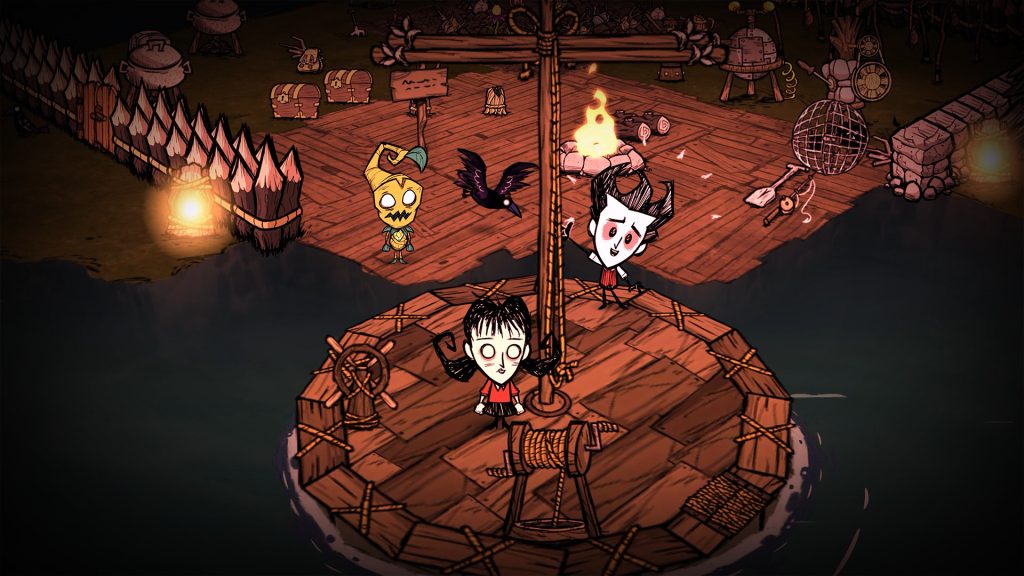
Once the nautical recipes are available, the entry item is the boat kit. You craft it, carry it to open water, and place it. The result is a floating platform with a small deck: not yet a vehicle, just a raft you can stand on.

What parts does a working boat need?
Three, in order of importance:
- A steering wheel, so you can choose a direction instead of drifting with the current.
- A sail, which provides propulsion. Without one you are a passenger on wherever the water takes you.
- An anchor, so you can stop. This is the part everyone forgets and then discovers they cannot park.
Build all three before you leave sight of shore. A boat with a sail and no anchor drifts past your destination, and a boat with a wheel and no sail does not move at all.
Beyond the basics, boats can be extended with deck space, storage, light and more, but those are refinements. The three-part kit is what makes a boat functional.
How do you actually steer?
Stand at the steering wheel to take control, and the sail provides the push. You are not fighting realistic wind physics — you point the boat and it goes, with the caveat that momentum is real and stopping requires the anchor. Approach obstacles slowly, because a collision damages the hull.
The practical habits that keep boats alive: keep away from rocks and shoreline clutter, anchor before you leave the wheel to do anything else, and never jump off a moving boat to grab something on shore.
Why do boats sink?
Two causes: collisions and creatures. Hitting rocks, sea stacks and debris damages the hull, and enough damage sinks the boat, dumping you into the water — which is usually fatal unless you can swim to something. Sea creatures actively attack boats, and some of them are dangerous enough that fighting them from a small deck is a mistake.
The counter is preparation: carry repair materials so you can patch a damaged hull before it fails, keep moving rather than sitting still in open water, and disengage from fights you cannot win from a boat. Repairing early is cheap; swimming is not.
What is the ocean actually for?
Several things worth the trouble. Ocean exploration opens up islands with unique resources and characters, sea-based food sources, and content that is simply not reachable on foot. Some of the most valuable late-game materials come from the water, and the ocean is also a way to bypass dangerous land routes.
For a group, the ocean is also a shared project: one boat, several players, and a destination nobody has mapped yet. That is a different kind of play from base-building, and it is worth doing at least once.
What should you take on a voyage?
- Repair materials for the hull, in quantity.
- Light — a lantern or miner hat. Night at sea is as dark as night anywhere.
- Food and healing, because you cannot forage mid-ocean the way you can on land.
- An anchor already fitted, plus spare parts for whatever breaks.
The rule of thumb is to provision a boat trip like a cave expedition, not like a walk to the next biome. Distance from base is the real danger, not the water itself.
How do you deal with sea creatures?
Sea creatures are the difference between a boat as transport and a boat as a fight you did not choose. Some are curious rather than hostile and will follow the boat for a while without attacking; others will ram the hull or come over the side. Learning to tell them apart saves a great deal of repair material, because fleeing from a curious animal wastes time and fleeing from an aggressive one wastes time if you leave it too late.
The practical doctrine is avoidance first. Change heading early when something large is in your path, keep moving rather than parking in open water, and only fight when the creature is already committed and you have room to manoeuvre. Fighting from a small deck means the boat is taking damage while you are occupied, and a damaged boat in open water is a much worse problem than an unwanted animal.
What are common sailing mistakes?
- Sailing without an anchor. You cannot stop where you want.
- No repair materials. One bad collision ends the trip.
- Leaving the wheel while moving. The boat keeps going.
- Sailing at night without light. You cannot see hazards in time.
- Fighting every sea creature. Some are there to be avoided.
FAQ
Can you build a boat anywhere? You place it on open water, not on land.
Do boats have storage? You can add storage to a boat, but a bare hull has none.
What happens if your boat sinks? You end up in the water, which is usually a death sentence far from shore.
Can multiple players ride one boat? Yes, and it helps — one steers while another repairs or fights.
Is sailing worth it early? Not before you have a stable base and spare materials.
Next step
Provision properly before you launch — see how to get a lantern for light and how to restore health for the damage you will take. For faster land travel, read how to move through wormholes.