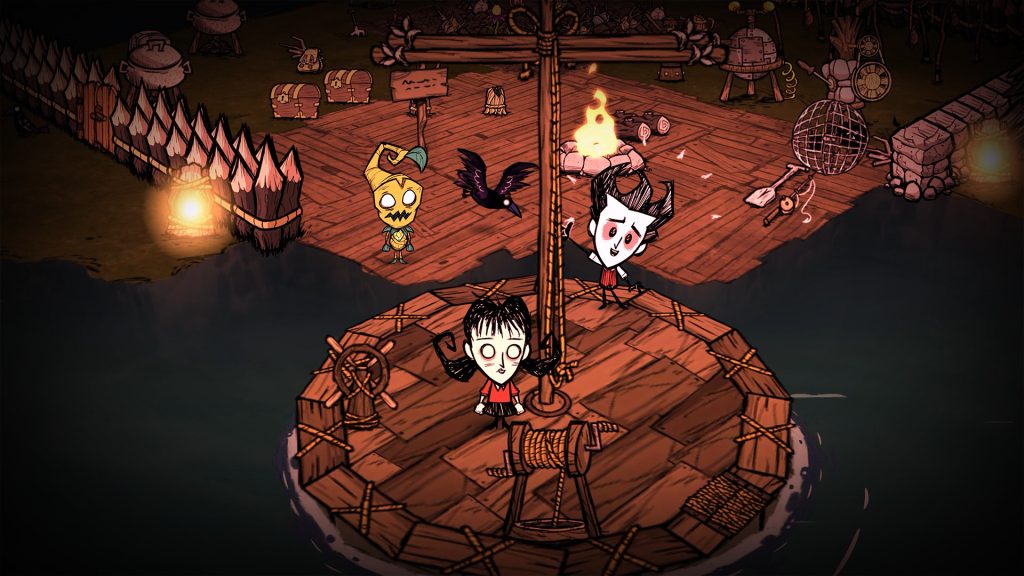
Don’t Starve Together: How to Get a Lantern
Quick answer: a lantern is a hand-held light you craft at the science tier. The parts are ordinary — twigs and rope — with one exception: a firefly, which you catch at night with a bug net near ponds and forest edges. Unlike a torch, a lantern does not burn down your base, lights a wide area, and frees both hands for tools. That combination makes it the first light source worth investing in.
Light is the most important resource in Don’t Starve Together, and the torch is a bad long-term answer: it burns out fast, it sets things on fire, and holding it means you cannot hold anything else. The lantern solves all three problems at once, which is why it sits at the centre of every serious base plan.
Why is a lantern better than a torch?
Three reasons, all practical. It lights a larger area, so you see threats before they see you. It does not ignite anything, so you can use it inside a base full of wooden structures without gambling your entire build. And it is a separate item from your tool slot, which means you can carry it and still chop, mine or fight.
The torch is still worth carrying as a backup, because it is cheap enough to make from grass and twigs in an emergency. But as your default light, it is a beginner’s tool that costs more over time than it saves.

What do you need before you can craft one?
You need the science tier unlocked. That means building a Science Machine, which is the first crafting bench and the gate for most early technology. Until it exists, the lantern recipe simply is not on your list, and no amount of materials will make it appear.
The Science Machine itself is cheap — basic gathered materials — and it is the single most important early structure, so this is not a real barrier. Build it on day one or two.
What is the awkward ingredient?
Fireflies. The lantern is built from twigs and rope, both trivially renewable, plus a firefly, which you cannot simply pick up during the day. Fireflies appear at night in specific places — near ponds, around forest edges, in the sort of ground that looks damp and overgrown — and catching one requires a bug net.
So the real progression is: build a Science Machine, craft a bug net, go out at night and catch a firefly, then craft the lantern. That is a two-night project at most, and it is the step players most often skip when they wonder why the recipe is greyed out.
Because fireflies only show at night, this is also the moment to be careful about darkness. Go out with a torch, catch what you need, and come back — do not wander a dark map hunting for a second firefly with no light of your own.
How do you keep a lantern running?
A lantern has fuel, and it burns down as you use it. Refuelling is the ongoing cost, and the good news is that the fuel is renewable and easy to stockpile at base rather than something you have to hunt. Treat refuelling as part of your return-to-base routine: come in, top up the lantern, top up your food, go back out.
Leaving base with a half-empty lantern is the single most common way to die in a cave. Check it before you leave, not after it goes dark.
What are the alternatives?
Several, and each fits a different situation:
- Miner hat — a head-slot light that leaves both hands free. Excellent in caves and while mining, since you can swing a pickaxe and see at the same time.
- Torch — cheap, disposable, dangerous near structures.
- Campfire and fire pit — fixed light for a base, not for travel.
- Glow-producing plants and foods — situational and usually temporary.
Most players end up carrying a lantern for general travel and a miner hat for underground work. They solve slightly different problems, and owning both is not redundant.
Where does light matter most?
Two places: the Caves and the Ruins, and winter nights on the surface. Underground, losing your light is almost always fatal within seconds because the darkness itself damages you and the terrain is unfamiliar. On the surface in winter, long nights mean more of your working day happens in the dark, so a reliable light extends what you can do.
This is why the lantern is not a luxury item. It is the thing that makes underground exploration possible at all, and underground is where the game’s best resources are.
Does a lantern work in the dark areas specifically?
Yes, and that is where it earns its place. Underground areas are larger than they look and are built around light as a hard constraint: you must be able to see the ground you are standing on, because the darkness itself deals damage and the terrain is full of edges, holes and drops. A lantern gives you enough radius to walk confidently and enough warning to see something moving before it reaches you.
It is worth understanding that underground darkness and surface night behave the same way mechanically — the danger is being in it, not being seen in it. That means the correct response to a dying light underground is not to push on hoping to find an exit, but to stop, light a torch if you have one, and either refuel or turn back while you still know where you are.
What are the common lantern mistakes?
- Not building the Science Machine first. The recipe never appears.
- Forgetting the bug net. You cannot catch a firefly bare-handed.
- Leaving base with low fuel. The classic cave death.
- Using a lantern as your only base light. It burns fuel; a fire pit does not.
- Carrying a torch instead and burning the base down. It happens more than anyone admits.
FAQ
Can you craft a lantern without a Science Machine? No, the science tier is required.
Where do you find fireflies? At night, near water and forest edges. Bring a bug net.
Does the lantern ever break? It runs out of fuel rather than breaking, and refuelling keeps it going indefinitely.
Is the miner hat better? For mining and caving, often yes, because it frees your hands.
Can you use a lantern in the rain? Yes; unlike a torch it is not extinguished by weather.
Next step
With light sorted, plan your first underground trip with our guide to finding the Ruins, and keep yourself alive down there with how to restore health.