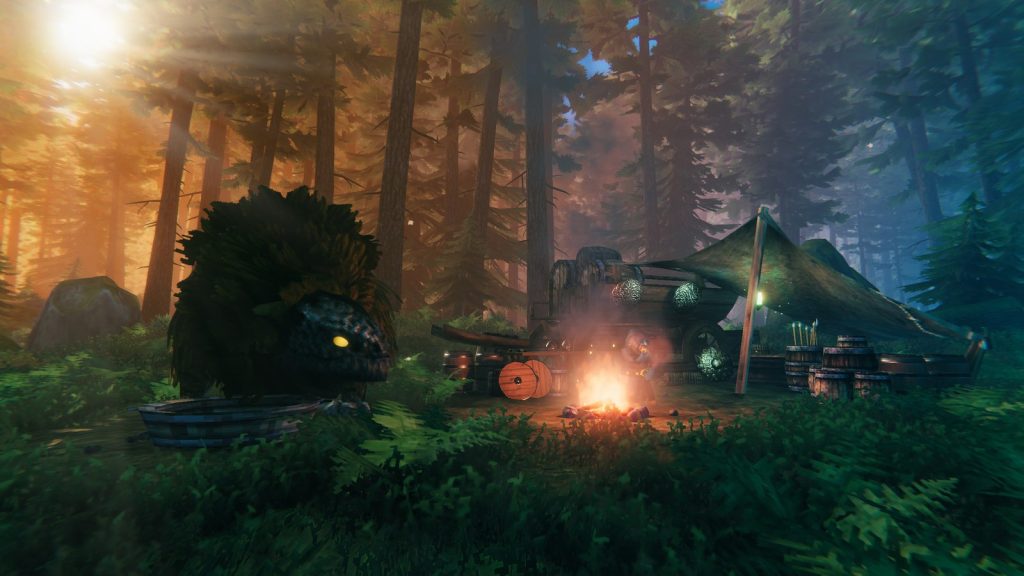
Quick answer: Choose Escape Simulator for a three-person puzzle room, Overcooked! 2 for kitchen teamwork, or Valheim and Terraria for a continuing shared world.

On this page
Best co op games for three players: give everyone a role
Escape Simulator is an especially clear fit for an online trio because its developer recommends up to three people for built-in rooms. Overcooked! 2 gives three chefs a common timed task. Trine 4 combines puzzle solving and platforming, while Terraria and Valheim suit a team that wants to return to a shared world. Choose the session style first: one room, several short levels, or an ongoing project.
This is a documented-fit comparison using active participation, mode support, session length, task sharing, and hosting requirements. It is not a firsthand balance study. A game with three heroes is not automatically a three-person game in every mode, and a game that supports four people may still work well with three. The important question is whether the selected cooperative mode includes all three friends comfortably without requiring one person to watch a two-player campaign.
| Game | Group or focus | Play arrangement | Decision factor |
|---|---|---|---|
| Escape Simulator | Online room | Developer recommends up to three | Clue hunting |
| Overcooked! 2 | Local or online team | Up to four chefs | Short shared challenges |
| Trine 4 | Local or online co-op | Check mode selection | Adventure puzzles |
| Terraria | Online world | Shared world and equipment | Open-ended exploration |
| Valheim | Online world | One to ten supported | Building and expeditions |
Escape Simulator: search one room as a trio
Escape Simulator’s official page recommends up to three players for built-in online rooms, while allowing larger groups. A trio can divide clue hunting without making the scene crowded. Agree that players announce useful discoveries and moved objects. When one person finds a code reference, another can inspect the lock while the third checks how the pieces relate. Everyone remains involved in a common problem rather than waiting for a turn at one input.
The drawback is information chaos if every participant independently moves or solves objects without explaining what happened. Keep a recognizable workspace and share important observations before committing to an answer. Built-in rooms are the predictable starting point; community rooms can differ in puzzle design and computer requirements. The store specifically warns that some large community rooms require more memory and graphics capability. Test one ordinary room with the full trio before downloading a long custom-room itinerary or assuming every user-created room fits three equally well.
Overcooked! 2: share a four-capacity kitchen with three chefs
Overcooked! 2 supports up to four players in couch or online play. That provides space for a three-person team without asking the group to find a fourth person before starting. Assign responsibilities around the particular kitchen instead of assuming each chef must perform the same task. One participant might prepare ingredients while another manages cooking and the third handles delivery or plates; change the arrangement as the scene changes.
The downside is time pressure and the temptation for one person to become a permanent supervisor. If the group repeatedly misses orders, simplify the plan and teach one skill at a time. Choose early levels while the trio learns how to move around each other. Match Overcooked! 2 editions and check the actual platform connection instructions. This recommendation is based on its documented local and online modes; it does not infer universal cross-platform cooperation from the existence of a different Overcooked compilation with its own features.
Trine 4: combine a trio’s ideas and abilities
Trine 4 returns to a fantasy adventure with three familiar heroes and both local and online cooperative categories. It is worth considering when a trio likes manipulating objects, using abilities, and crossing platforming obstacles together. Check the available cooperative mode and character rules in the menu before assigning permanent roles. Character artwork and the title’s premise are useful context, but they are not a substitute for the selected mode’s actual controls.
The drawback is mixed challenge: someone may enjoy environmental puzzles but struggle with jumps or action. Let the group practice abilities in a safe scene and avoid allowing the fastest player to rush every problem. If all three are trying different solutions simultaneously, ask for one experiment at a time so each person understands the result. The current storefront describes an optional Melody of Mystery expansion as a separate purchase. Confirm that everyone has the required content for the planned session rather than treating all advertised levels as part of the base campaign.

Terraria: keep three different activities in one world
Terraria’s online cooperation can bring a trio into the same two-dimensional exploration and building world. It fits friends whose interests differ: construction, underground exploration, and equipment preparation can all contribute to the next group objective. Decide which discoveries and boss encounters require all three people to be present. This lets independent activity remain useful without letting one person’s progress determine the whole group’s direction.
The limitation is that open-ended play can split the team into unrelated tasks for long stretches. Make occasional group goals, such as preparing an area or exploring an unfamiliar region together. Agree on outside equipment because character inventories and shared worlds are separate parts of the arrangement. An advanced character can reduce the value of a fresh group’s early progression. Match the PC release and version before setting up a world; the Steam listing’s Windows, macOS, and Linux support does not establish compatibility with console or mobile Terraria.
Valheim: build a home for three returning explorers
Valheim supports one to ten players in its official description, so a trio fits within its documented cooperative capacity. Its cycle of building, food preparation, exploration, and bosses provides several useful responsibilities. Choose it when the group wants a place to return to over multiple sessions. Shared construction and expedition preparation can let three people contribute differently while working toward a recognizable common goal.
The drawback is coordinating a persistent world. Discuss who hosts it and when major progression happens. If one person is available much more often, decide what they can change independently and what should wait for everyone. A dedicated server may help availability, but it is a separate technical arrangement rather than an automatic benefit of buying the game. The group should also understand survival and recovery before treating Valheim as a casual building room. Begin with a modest base and an achievable nearby expedition so the trio can learn its preferred pace.
Eliminate two-player-only campaigns before the purchase
If all three friends expect active roles, remove games designed exclusively around a pair from the starting shortlist. Portal 2’s dedicated cooperative campaign and We Were Here Forever’s puzzle premise both use two people. Passing a controller or having a third friend discuss a solution can be fun when everyone agrees, but that is a different arrangement from three simultaneous players with documented in-game roles.
Next decide how long the trio normally has to play. A short meeting favors a room or level that can provide a clear stopping point, while a regular weekly session may suit a persistent world. Test the exact local or online setup, check every participant’s input device, and make a simple opening objective. If one person’s preferred activity is always postponed, rotate choices between evenings. Supported capacity answers whether the game can include the trio; shared preferences decide whether it should.
Questions about three-person co-op
Do we need a game designed for exactly three?
No. A four-capacity cooperative mode can often include three, and a larger shared world can work with a small team. Confirm the selected mode’s supported count. Escape Simulator’s explicit built-in-room recommendation is useful, but the game’s activity still needs to suit the participants.
Is a game with three characters proof of three-player support?
No. Story characters, local limits, online limits, and mode rules are separate facts. Check the official multiplayer description and the game menu. Trine 4 is a candidate here because its documented co-op categories support the recommendation, not merely because its art shows three heroes.
What if one friend cannot join every week?
Choose an arrangement that preserves their participation. Keep major world progress for group meetings, or favor self-contained rooms and levels that do not require following a long campaign. Clarify host availability so the remaining pair is not locked out of the shared save unexpectedly.
Sources and method
Official sources checked November 11, 2026. Recommendations compare documented play arrangements and practical fit. Exact current prices, measured hardware performance, and personal playtests are not claimed.