TL;DR: The best co op games for two players on PC depend on what you want to do together: Split Fiction for an action campaign, Portal 2 for physics puzzles, We Were Here Together for communication puzzles, Stardew Valley for a shared farm, Deep Rock Galactic for repeatable shooter missions, and Unravel Two for local platforming.
For a pair who wants a clear beginning and ending, start with Split Fiction or Portal 2. For a standing weekly session, choose Stardew Valley or Deep Rock Galactic. If both people share one PC, avoid online-only picks and confirm your controller setup before buying.

On this page
How these two-player PC games were selected
Each pick has documented cooperative play and a useful reason to choose it over the others. The priorities are whether two people can participate meaningfully, whether one PC or two is required, how much control learning is involved, and whether the game fits a single session or an ongoing commitment. These are editorial fit recommendations based on official pages, not a claim that every game was personally tested.
“Two-player” can mean an adventure written exclusively for two people, or a game that supports a pair within a larger group limit. Both can work, but they create different expectations. A third friend can join Stardew Valley or Deep Rock Galactic later; Split Fiction and Portal 2 remain two-person cooperative experiences.
| Game | PC session | Best fit | Main learning cost |
|---|---|---|---|
| Split Fiction | 2 local or online | Dedicated action campaign | Timing and changing abilities |
| Portal 2 | 2 local or online | Shared puzzle solving | First-person movement and portal logic |
| We Were Here Together | 2 online | Talking through different clues | Microphone communication |
| Stardew Valley | 2 works locally or online; PC online up to 8 | A farm you keep returning to | Menus and the passing day |
| Deep Rock Galactic | 2 works; online up to 4 | Repeatable action missions | Aiming, navigation and class tools |
| Unravel Two | 2 local; no native online lobby | Same-room platforming | Jumping and rope coordination |
1. Split Fiction: choose a campaign built around both players
Split Fiction is the strongest fit here when both people want to work through a designed adventure together. Its science-fiction and fantasy worlds keep changing the tools each player uses, so cooperation is part of the level design rather than an optional second character following the leader. Plan to learn new actions throughout the campaign.
The PC release supports two-player local split-screen and online co-op. Local play means both people share the machine; online play means each person runs the game on their own device. EA also documents Friend’s Pass, which lets an owner invite a friend to the supported online campaign without requiring that friend to purchase a second full copy. Follow the pass’s current account and download requirements.
The official EA page confirms crossplay across PC, PlayStation, Xbox and Nintendo Switch 2. Nintendo Switch 2 is a specific platform here; the original Switch is not the same release. This makes Split Fiction useful if a PC player later wants to continue with a console partner.
The drawback is the changing action demand. A player who is still learning to move a camera and jump can find a new mechanic disruptive just as the old one becomes comfortable. Choose it for a pair willing to retry and learn together. If one partner wants a slow conversation with little pressure, the farm or puzzle choices below are better first sessions.
2. Portal 2: choose puzzles that require shared understanding
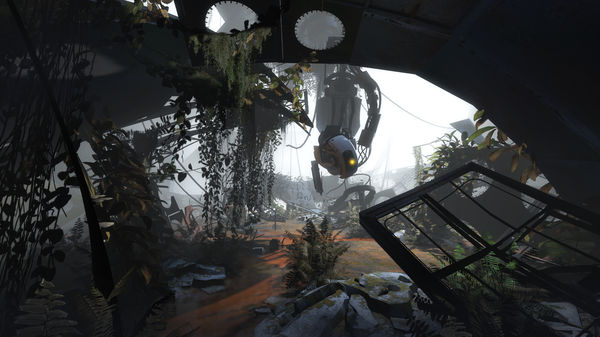
Portal 2 has a separate two-person cooperative campaign. It is not simply the single-player story with another body added. Each player controls a robot and uses portals, with chambers built around the information and actions of both people. The official store confirms both online and shared or split-screen co-op on PC.
Choose it when you enjoy stopping, pointing out a possibility and testing a plan. One player can identify a route while the other experiments with where a portal should go. The useful skill is explaining cause and effect: what changes when a button is pressed, where a surface leads, and whether your partner can safely reach the next position.
First-person controls remain a real barrier. Someone unfamiliar with moving and looking at the same time needs room to learn, even though the central task is puzzle solving rather than competitive shooting. Begin patiently and use the game’s communication tools before treating every missed jump as a failure to understand the puzzle.
Portal 2 is a better fit for a fixed puzzle campaign than endless replay with fresh progression. Solutions lose some surprise after you know them, although community cooperative chambers provide additional material. For the recommendation here, match two PC copies or the documented local mode; this article does not rely on legacy console-to-PC crossplay services.
3. We Were Here Together: choose it when talking is the game
We Were Here Together suits two remote players who enjoy describing things they can see but their partner cannot. The official Steam description calls it co-op only and requires both players to have a working PC-compatible microphone and an internet connection. This is an online pair’s game, not a one-computer couch recommendation.
The distinction from Portal 2 is the information gap. You cannot always solve a room by both staring at the same object. Clear descriptions become the shared tool: a symbol’s shape, a sequence’s order, or which part of a mechanism changed. This is appealing to friends who enjoy escape rooms and verbal reasoning.
Set up microphones before launching and agree on names for repeated symbols. “The one that looks like a fork with a circle” is more helpful than “the weird one.” Let both people finish a description before making another guess. A partner who stays quiet while rapidly clicking can turn a solvable task into confusion.
The main drawback is that it depends heavily on active communication and patience. It is a poor choice if one person wants to listen to a podcast, cannot use a microphone, or gets tired of being separated. Use two PCs for this recommendation and confirm the current supported platform pair separately if buying for a console friend; a general store multiplayer tag is not a complete compatibility matrix.
4. Stardew Valley: choose a project instead of a fixed campaign
Stardew Valley is the choice for two people who want a place to return to. You share a farm while growing crops, gathering resources and developing skills. Its official PC listing supports online, LAN and split-screen cooperative play, and the developer’s 1.6 notes confirm up to eight PC players online. A pair can keep the farm small without filling every available slot.
Its strength for an uneven pair is the variety of jobs. One person can enjoy planning the crop layout while the other fishes, explores or handles animals. Agree on shared goals so different activities still feel like a joint project. A modest first goal, such as improving the farm’s basic routine, is more approachable than copying an optimized year-one checklist.
This is quieter than an action campaign, but “cozy” does not mean no learning. Inventory, tool selection and the passing day can frustrate someone encountering game menus for the first time. Explain one task at a time and leave room to make inefficient choices. A farm that reflects both people is usually a better co-op experience than one player issuing every instruction.
Plan around the host and the same PC build. The developer explicitly requires matching build numbers as well as versions for multiplayer. Do not buy a console copy assuming it will join this PC farm; the recommendation is for matched PC editions. Local split-screen is useful for a shared machine, but the online eight-person limit should not be read as eight local panels.

5. Deep Rock Galactic: choose repeatable missions with clear roles
Deep Rock Galactic works for two players who enjoy shooting and want a repeatable session structure. The official description supports one to four online players exploring destructible caves, mining materials and surviving alien attacks. A pair can participate without recruiting a full four-person team.
Different classes give players tools that affect movement, combat and access. That produces a useful decision before a mission: who can help the pair reach awkward terrain, who is comfortable handling enemies, and how will you find the way back? A friend contributing a traversal tool is doing more than adding another gun.
Choose a low-pressure introduction and let both people learn their class equipment. A new player needs time to understand mining, ammunition and the route through a cave as well as aiming. Keep the first missions focused on reading the objective and staying together. Increasing the challenge is something to do after the pair understands those basics.
The downside is that it remains a first-person shooter with enemies and navigation demands. It is not the easiest choice for someone who dislikes combat or camera movement. It also has no local split-screen in the documented PC listing, so plan separate PCs. Match the storefront and verified multiplayer network before buying; this recommendation uses the Steam release and does not promise Steam joins every other PC or console edition.
6. Unravel Two: choose same-room help and rope puzzles
Unravel Two is a focused option for two people sharing a PC. The official description explicitly offers local co-op with two Yarnys connected by yarn. Platforming and puzzle situations use that connection, making the partner’s position part of how you get through a space.
The side-on view removes the extra task of manually controlling a three-dimensional camera. That helps a pair who wants to talk through a jump or a rope-based solution while seeing the same scene. Both people can understand where the other is standing without constantly interpreting separate first-person views.
Do not mistake Steam’s user-defined “Online Co-Op” tag for a developer promise of a native online lobby. The official feature list and description identify local shared-screen cooperation. Remote streaming is a separate arrangement with its own latency and controller constraints. For this recommendation, sit together and connect suitable separate inputs.
The drawback is precision platforming. An approachable camera does not remove timing challenges, and two players can still become stuck on the same jump. Choose it if your pair enjoys working through movement puzzles. If missing a jump makes one person want to stop immediately, try Stardew Valley’s quieter tasks or a deliberately patient Portal 2 session instead.
Which game fits your next evening?
For a scheduled campaign with one friend, choose Split Fiction if you both enjoy action, or Portal 2 if thinking through chambers is the draw. For two remote friends who want conversation to be essential, choose We Were Here Together. For a lasting shared routine, start Stardew Valley; for repeatable combat missions, use Deep Rock Galactic.
If you share one PC, the local candidates are Split Fiction, Portal 2, Stardew Valley and Unravel Two. Check controller recognition before settling down. Our co-op picks for new players focus more closely on the control-learning barrier, while the crossplay guide addresses friends on different platforms.
Frequently asked questions
Does every two-player PC game need two purchases?
No. Local play normally uses the game running on one machine, while Split Fiction documents a Friend’s Pass route for an invited online partner. Do not assume that pass model exists in every other game. Check the exact online access requirements on its official store.
Is local co-op the same as LAN?
No. Local shared-screen play uses one machine. LAN typically uses separate machines on the same network. A store supporting one does not automatically support the other; Stardew Valley explicitly lists both, while the online-only picks require their own setup.
Next step: Agree on one PC or two, then choose the activity you both want to repeat. Verify the relevant mode and inputs before purchasing; the best fit is the game that lets both people participate comfortably.
Sources and version notes
- Split Fiction on Steam
- Split Fiction Home – Electronic Arts
- Portal 2 on Steam
- We Were Here Together on Steam
- Stardew Valley on Steam
- Stardew Valley – Stardew Valley 1.6 Update Full Changelog
- Deep Rock Galactic on Steam
- Unravel Two on Steam
Official developer, publisher and storefront pages read November 11, 2026. Recommendations reflect documented features and editorial fit; no personal playtest, price comparison, benchmark or measured SEO score is claimed. Platform and mode limits refer to the editions named in the article.