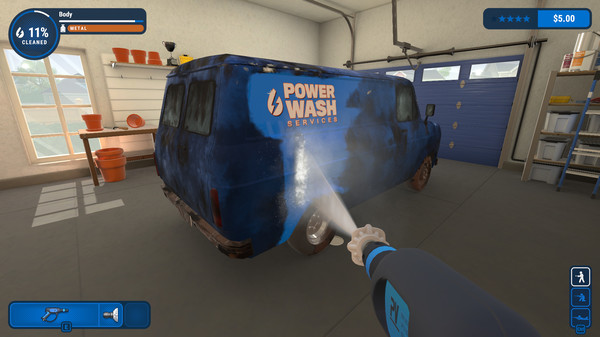
TL;DR: White 40-degree gives broad coverage, green 25-degree balances coverage and pressure, yellow 15-degree narrows the fan, and red zero-degree concentrates the strongest standard pressure on a tiny spot. Turbo and Soap are purchased tools with different purposes. Triple Tip is a late Prime Vista PRO attachment, not a starting nozzle for every washer.
This PowerWash Simulator nozzle guide covers the original game’s equipment. Pick a nozzle for the surface, dirt toughness, and distance in front of you. The option that cleans a tiny stubborn spot well is not automatically the quickest way to cover an easy wall.

On this page
PowerWash Simulator Nozzle Guide: Match Coverage and Pressure
Every regular washer includes four standard nozzles. Their fan width trades area coverage for pressure and useful reach. Start with a middle option to see how the surface responds, widen when a pass cleans easily, and narrow when the dirt remains.
Avoid evaluating pressure alone. A zero-degree stream has little area coverage, so it requires careful passes across a broad surface. A white fan can be efficient on easy dirt but ineffective at a long distance or against a tougher layer.
Watch the surface changing under the spray. If dirt remains, try a small change in position and nozzle before buying another attachment. A hidden angle, obstruction, or poor distance can look like insufficient pressure even when the current washer is capable of the job.
| Nozzle | Purpose | Tradeoff |
|---|---|---|
| White 40-degree | Easy large surfaces | Lowest standard pressure and shorter useful reach |
| Green 25-degree | General cleaning | Compromise rather than maximum pressure or width |
| Yellow 15-degree | Tougher dirt with some coverage | Narrower fan takes more passes on broad areas |
| Red zero-degree | Tiny stubborn patches and precise work | Very small coverage |
| Turbo | Rotating focused jet | Less precise over long distance; purchased per washer |
| Soap | Use suitable cleaning liquid | Requires liquid; weak without it |
| Triple Tip | High-pressure wider cleaning on Prime Vista PRO | Late, model-specific attachment |
1. Begin With a Useful Middle Fan
Green is a practical starting check on an unfamiliar surface because it provides a balance of width and pressure. If it clears dirt readily, white can increase your coverage. If the same area resists, yellow or red can give more focused pressure.
This is a test sequence, not a rule that every job must be cleaned with green first. A familiar easy wall can begin with white, and a small stubborn detail can begin with red. Match the tool to the task you can see.
Sweep at a speed that lets the dirt disappear. Passing a wide fan too quickly can leave streaks, while holding a narrow stream on a finished spot adds no useful coverage. Use overlapping passes when the surface requires them, then check the part’s completion.
2. Rotate the Fan to Fit the Shape
The standard fan nozzles can rotate between horizontal and vertical spray orientation. The reference lists R as the default keyboard rotation key; use the named control in your settings on other devices or if you changed the binding.
An upright fan fits narrow vertical parts, while a horizontal fan suits some ledges and strips. Rotating the same nozzle can be enough to stop spraying harmlessly beside the intended target.
Turbo and Soap nozzles cannot be rotated in the same way. If the selected nozzle ignores the fan-rotation control, inspect the equipment type before trying to repair a control that is working as designed.
3. Adjust Distance Before Judging the Washer
Nozzle choice affects useful range as well as width. Moving close enough to reach the dirt effectively can improve a pass more than switching randomly through attachments. Aim at the actual surface rather than a foreground railing or edge.
Extensions increase reach, but their extra length reduces convenience at close range. The washer reference explicitly notes that longer extensions have poorer close-up coverage. Remove or shorten the extension when you are working beside the object.
If a nozzle cannot reach an underside cleanly, change your position. A stronger stream from the same blocked angle still cannot directly inspect a hidden surface. Use the job’s access tools and a lower viewpoint when necessary.

4. Use Turbo for Focused Coverage
Turbo sends a rotating zero-degree stream in a small circle. It maintains focused cleaning power while covering more area than a stationary tiny point, which can be useful for stubborn grime that would take many careful red-nozzle passes.
Its rotating pattern is less precise at range, and its behaviour varies with the washer and extension. Do not treat it as a perfectly accurate red nozzle with unlimited width. Move at a controlled speed and inspect the streaks left behind.
Turbo attachments are purchased separately for each washer model. Owning one for the starting washer does not mean it automatically transfers to every stronger washer you later buy. Check the compatible model in the shop and equipment menu before spending Career money.
5. Use Soap Only With the Right Liquid
The Soap nozzle is meant to dispense cleaning liquid. The nozzle reference states that it has practically no effect without cleaning liquid and that matching the liquid to the material improves its cleaning purpose. Verify the selected surface material and supply rather than expecting water-only soap to act like the red jet.
Soap is less effective at long range. Get to a workable distance and apply it where it solves a real problem. If an easy surface already cleans with a normal fan, using soap there may be an unnecessary Career expense.
Free Play provides unlimited cleaning liquids under its mode rules, while Career uses purchased supplies. That makes experimenting with soap more relaxed in a replay, but it does not change the Career budget for a new job.
6. Treat Triple Tip as a Late Upgrade
The Triple Tip is specific to the Prime Vista PRO and combines three zero-degree streams for high-pressure coverage. The reference describes a later progression unlock, so it is not a nozzle to look for on the starting Prime Vista 1500.
If the shop does not offer it yet, check your current washer and Career progress rather than assuming every attachment should be available immediately. The ordinary four nozzles, access tools, and appropriate distance remain useful before that late upgrade.
Use the beginner cleaning tips to keep a section-based route. Even powerful late equipment benefits from reading the unfinished part list and checking hidden angles instead of sweeping the whole scene repeatedly.
Frequently Asked Questions
Which nozzle is best for every job?
There is no single choice for every surface. Wide fans help easy area coverage, narrow jets help stubborn details, and purchased tools solve particular needs. Distance and angle also matter.
Why does my Soap nozzle barely clean?
Check that you have cleaning liquid selected, that it suits the material, and that the target is close enough. The nozzle is not a strong water-only substitute for standard pressure.
Does buying Turbo once unlock it for every washer?
No. Turbo attachments are model-specific purchases. Inspect the washer compatibility before expecting an attachment to appear on a different model.
Next step: Test a middle fan, observe the dirt, and change one variable: width, distance, orientation, or angle. Buy another attachment only after you know which recurring problem it will solve.
Sources and Version Notes
- Official PowerWash Simulator Wiki: Nozzles
- Official PowerWash Simulator Wiki: Power Washers and Extensions
- Official PowerWash Simulator Wiki: Free Play
- Official PowerWash Simulator Wiki: Career Mode
Sources read November 11, 2026. This article covers the original game and the stated edition or mode. Source-backed explanations are not claimed as personal playtesting, and newer patches can change interface details.