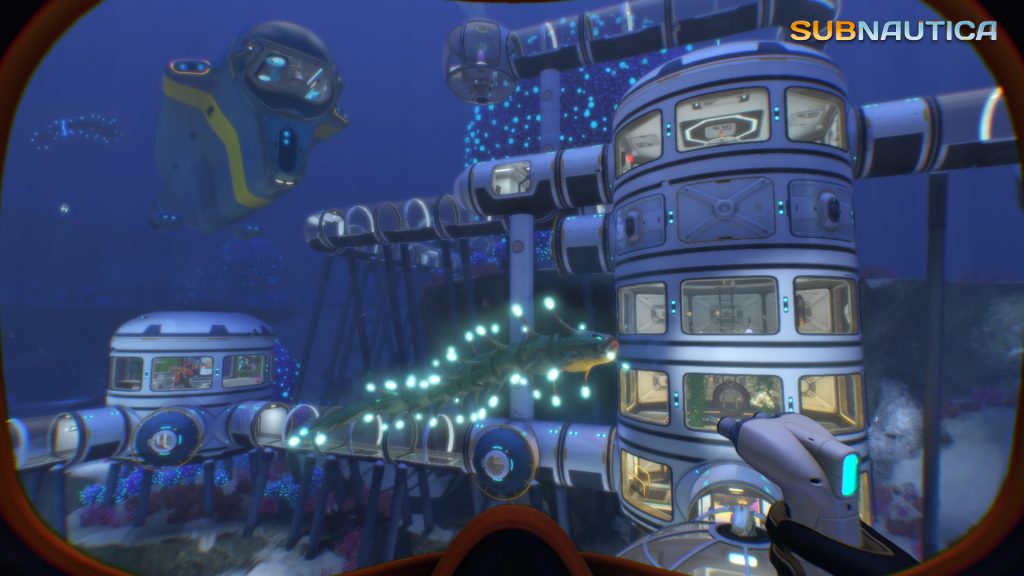
TL;DR: Build your first original-Subnautica base from a compartment, a hatch, and a power source. Put it in shallow, accessible water, add useful storage, and keep hull integrity above zero as it grows. If the base floods, restore integrity first and then repair the breaches.
This Subnautica base building guide focuses on making a dependable supply point. A powered underwater seabase provides oxygen and space for equipment that the lifepod cannot accommodate. A large room and a decorative glass wall are optional; reliable power, access, and useful storage matter immediately.
Choose a base for the trips you are making now. A beautiful deep location can be a poor first home if every missing ingredient means a long return to the Safe Shallows. You can build a forward outpost later without abandoning the practical base that supplies it.

On this page
Subnautica Base Building Guide: Gather Your First Materials
The Habitat Builder creates base sections and appliances. Its documented recipe is a wiring kit, a computer chip, and a battery, crafted at the Fabricator. Check the individual component recipes and gather their materials before leaving to build.
Bring enough material for a compartment, a hatch, and the chosen power source as one complete package. A half-built underwater room with no power is not the breathing stop you were expecting. Keep construction supplies separate from the food, water, and tool charge needed for the trip.
You already have the basic blueprints needed for a small starter base. Additional room types and appliances come from exploration, fragments, data boxes, and scanning abandoned structures. Do not delay a functional compartment just because a tutorial begins with a Multipurpose Room you have not unlocked.
2. Pick a Location You Can Supply
A shallow site near the Safe Shallows, Kelp Forest, and grassy areas keeps early resource trips manageable. Choose seabed with space for the entrance and later expansion. Leave access for your vehicle rather than surrounding the hatch with awkward obstacles.
Solar panels work best near the surface, which makes shallow water convenient for a first solar-powered base. A deep location needs a more deliberate power plan. Depth also makes hull-integrity costs more demanding as you add underwater sections.
A foundation is useful for a level building surface and extra integrity, but it is not mandatory for the first compartment. Build near appropriate ground or on a foundation, then attach the hatch where you can reach it comfortably. Confirm the entrance before using the building as a supply marker.
3. Connect Power Before Depending on Oxygen
Underwater seabases produce oxygen when supplied with power. If stored power runs out, oxygen is eventually lost. Before counting a remote base as a refuge, check its power indicator and the operation of its appliances.
| Power source | Good reason to use it | Planning requirement |
|---|---|---|
| Solar Panel | Simple shallow-base start | Light and stored energy for dark periods |
| Bioreactor | Power from organic fuel | Unlocked room and a fuel routine |
| Thermal Plant | Power near a suitable heat source | Placement and connection to the base |
| Nuclear Reactor | Later sustained power supply | Blueprints, suitable room, and reactor rods |
Solar panels and thermal plants can connect from outside the base; Power Transmitters support longer connections. Bioreactors and nuclear reactors are installed in appropriate rooms. A generator placed nearby is only useful when the base actually receives its energy.
Remember that appliances consume power. Battery charging, active scanning, and water filtration can change the demand considerably. If power repeatedly empties at night, add capacity or reduce demand rather than repairing a perfectly intact wall.
4. Add Storage and Equipment in a Useful Order
Start with lockers and a Fabricator, then add appliances that solve your current problem. Keep frequently used raw materials together and label storage by purpose. A named locker for electronics reduces the time spent searching for one ingredient among several unrelated piles.
A Battery Charger supports reusable tool batteries once unlocked. It needs base power, so installing it without adding sufficient generation can shift a charge problem into a base-power problem. Keep a spare battery for the equipment needed to leave the base safely.
Growing food and useful plants can reduce repeated collection trips. An Exterior Growbed is particularly useful for underwater plants such as gel sacks. Our aerogel crafting guide explains why retaining planting material makes that advanced resource chain easier.
A Scanner Room is useful when local searching is the bottleneck. It is an appliance with active power demand and a local search area, so choose its position around the resource area you actually want to scan.

5. Watch Hull Integrity as You Expand
An underwater base starts with an integrity reserve, but adding many sections consumes it. Glass and other structural choices can make expansion more demanding. The game reports integrity changes during construction, so read those messages before adding another module.
Reinforcement panels, foundations, and bulkheads provide ways to increase integrity. Depth raises the integrity reduction associated with building sections. Keep a positive margin instead of expanding until the next window immediately starts a flood.
If integrity reaches zero or below, breaches begin appearing. Increase integrity by adding strengthening components or removing sections that reduce it, then use the Repair Tool on the leaks. Repairing holes while leaving the underlying integrity problem unresolved invites another failure.
A vehicle collision can also damage a base. That can create a local breach even if structural integrity remains positive. Check both the integrity and the visible damage, rather than assuming every flooded room was caused by the same problem.
6. Make Expansion Serve the Next Expedition
A forward outpost can be small: a hatch, compartment, power, and selected supplies. It exists to shorten a particular journey, provide breathing space, or store expedition materials. Bring the complete construction kit before traveling so the outpost can function as soon as it is built.
Keep the route between the outpost and the resource area marked. A powered room does not help if you lose it behind unfamiliar terrain. Use the magnetite guide to plan a focused gathering trip rather than treating a new base as permission to search indefinitely.
The Cyclops fragment guide covers the submarine that eventually becomes a mobile supply platform. It complements fixed bases but has its own power, depth, and maneuvering requirements.
Diagnose a Dark or Flooded Base
For a dark base, check generation, connection, and stored power. Confirm that the generator is working in its environment and that the connection reaches the correct base. Temporarily reduce appliance demand if the supply cannot keep up.
For flooding, inspect integrity and breaches. Restore a positive structural margin, repair the damage, and wait for the water to clear. If integrity is already positive, look for collision damage and unrepaired holes rather than adding endless reinforcement.
Frequently Asked Questions
Do I need a foundation before building a compartment?
A foundation is optional. It supplies integrity and a convenient surface, but a first compartment can be placed on suitable seabed without one.
Do land bases need power to provide oxygen?
Land bases differ from underwater bases: power is needed for their appliances, but not to provide breathable air. This guide’s power-and-oxygen warning applies to underwater seabases.
Does Creative mode use the same power requirements?
Creative changes these requirements. Use Survival or Freedom rules when planning a functioning base in those modes rather than assuming Creative behavior carries over.
Next step: Build one accessible powered compartment, organize its storage, and test the supply before adding rooms.
Sources and Construction Scope
- Subnautica Wiki: Seabases documents minimum construction, hull integrity, generators, appliances, and oxygen.
- Subnautica Interactive Map: Habitat Builder provides the tool recipe. Sources were read November 11, 2026 and refer to original Subnautica.