TL;DR: The Cyclops blueprint needs three Hull fragments, three Bridge fragments, and three Engine fragments. Search the Mushroom Forest for Hull and Bridge pieces, then use a prepared visit to the Underwater Islands wreck or another documented Engine location. Nine scans only finish the blueprint if they complete all three categories.
Subnautica Cyclops fragments locations should be planned by the part you still need. Hull and Bridge fragments are documented in the Mushroom Forest and Sea Treader’s Path. Engine fragments have different sources, including the Aurora, Crag Field, Mountains, Crash Zone, and the Underwater Islands wreck. No route guarantees that every missing fragment sits together beside one landmark.
Open the blueprint progress before leaving. If Hull and Bridge are complete but Engine is still unfinished, another broad Mushroom Forest search can waste an entire trip. The scan name matters more than the shape of the debris.

On this page
Read the Three Separate Blueprint Counters
The Cyclops is assembled from three fragment sets. Each set requires three scans, so you need nine relevant scans in total. Scanning nine Hull fragments does not substitute for missing Engine pieces. Completed sets and repeated fragments are different kinds of progress.
| Fragment set | Scans required | Documented search areas |
|---|---|---|
| Hull | 3 | Mushroom Forest, Sea Treader’s Path |
| Bridge | 3 | Mushroom Forest, Sea Treader’s Path, Crash Zone |
| Engine | 3 | Underwater Islands wreck, Aurora, Crag Field, Mountains, Crash Zone |
Point the Scanner at a candidate and confirm its displayed identity before spending time on the scan. A familiar-looking piece can be another technology fragment. Keep a brief note of the missing set and remaining scans, particularly if you search over several sessions.
Start with Hull and Bridge in the Mushroom Forest
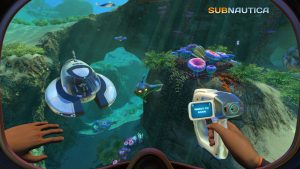
The Mushroom Forest is a useful starting area because two needed sets occur there. Search the seabed around the large mushroom trees and relevant debris. Move through a short sector systematically instead of circling one tree until your oxygen runs low.
Mark the area you are using with a Beacon. The northern forests contain landmarks that can look similar when you approach from another direction. A named marker makes it easier to return with supplies and distinguish an unfinished area from a sector you already searched.
Stay aware of the biome boundary. A forest search that drifts into a more dangerous neighboring region changes the risk without necessarily improving your chance of finding the missing part. Stop and reorient when the terrain or wildlife changes.
The Sea Treader’s Path is another documented source for Hull and Bridge pieces. Treat it as an alternative expedition with its own travel requirements, not a reason to abandon a manageable forest search after the first unsuccessful minute.
Plan a Separate Engine Fragment Trip
The Underwater Islands wreck is a documented Engine-fragment source and can be a useful alternative to searching near the Aurora. Its depth and wreck passages still demand preparation. Bring a charged Scanner, appropriate diving equipment, and any tools needed for the parts of the wreck you intend to enter.
Inspect accessible debris before entering the wreck. An exterior scan is different from an interior search through narrow corridors. Know the entrance and return route before passing into a section where you cannot simply swim upward.
The Aurora, Crash Zone, Mountains, and Crag Field offer other Engine locations. These are not interchangeable safety options. Radiation, hostile wildlife, approach direction, and your current equipment can each make one route unsuitable. Choose the best-prepared route rather than following a claim that a single area always contains the last three pieces.
Use a second trip when needed. Finishing the blueprint is a persistent goal, so you do not need to squeeze every scan into one outing. Leaving with two missing Engine scans is better than losing control of an oxygen-limited wreck search.
Prepare for Depth, Oxygen, and Tool Charge
A vehicle can provide a nearby oxygen refuge, but it also has a crush-depth limit. Check that limit before descending to the wreck or seabed. Park safely and keep the vehicle accessible; a refuge several unexplained turns behind you is unreliable.
Budget time for identifying the exit, avoiding a creature, or recovering from a wrong turn. The warning that your oxygen is low is not an instruction to start one final scan. Head back while there is still room for an imperfect return.
The Scanner and movement equipment need working batteries. Carry a reserve if the trip depends on them. For the basic equipment order, use the Subnautica beginner guide; for a supply outpost, the base building guide covers power and oxygen checks.

Build the Cyclops After Completing the Blueprint
The Cyclops is crafted at the Mobile Vehicle Bay. The documented original-game recipe is three plasteel ingots, three enameled glass, one lubricant, one advanced wiring kit, and three lead. Blueprint completion unlocks the construction option; it does not place those ingredients in your inventory.
Prepare the materials and deploy the bay in open water with enough room for a large submarine. If construction is unavailable, inspect the blueprint counters and the recipe requirements before assuming the game failed to register a fragment.
A new Cyclops has a different role from a small vehicle. It carries a Seamoth or Prawn Suit, supports storage and interior appliances, and uses power cells. Its size and controls require practice. Test short travel and docking before loading the whole expedition supply into it.
Depth modules extend the Cyclops’ operating depth. The base submarine is not automatically ready for every deep biome. Use the onboard indicators and plan upgrades around the next route, rather than assuming that building the largest vehicle removes depth restrictions.
When Progress Appears Stuck
Check which counter remains incomplete. If Engine is missing, target an Engine source. If the Scanner reports a completed set, repeated pieces will not fill another category. This is the most useful distinction to make before changing the entire route.
Search fresh terrain and inspect debris closely. A wide scenic pass can overlook a small fragment on the seabed. Slow down within a limited sector, verify scan names, and move to another sector once that one has been checked.
Use location lists as places to search rather than fixed spawn promises. This guide provides documented biomes and wreck areas without invented coordinates or a guaranteed fragment count for a particular save.
Frequently Asked Questions
Can I finish the Cyclops with only Mushroom Forest scans?
The forest is documented for Hull and Bridge pieces, while Engine fragments need a different source. Plan an Engine search separately instead of expecting all three sets from the same forest.
Do I have to enter the Aurora?
No. Other documented Engine sources include the Underwater Islands wreck, Crag Field, Mountains, and Crash Zone. Each route has hazards, so select one that matches your preparation.
Is the Cyclops available in Below Zero?
This blueprint and route belong to the original Subnautica. Below Zero uses different vehicles and progression; a guide for that game’s fragments will not complete this blueprint.
Next step: Check all three counters, write down the missing set, and plan one trip to an area that contains that set.
Sources and Blueprint Scope
- Subnautica Wiki: Cyclops documents three fragment sets, locations, depth modules, and submarine features.
- Subnautica Interactive Map: Cyclops provides the Mobile Vehicle Bay recipe. Both community sources were read November 11, 2026; route completion time and save-specific spawns were not measured.