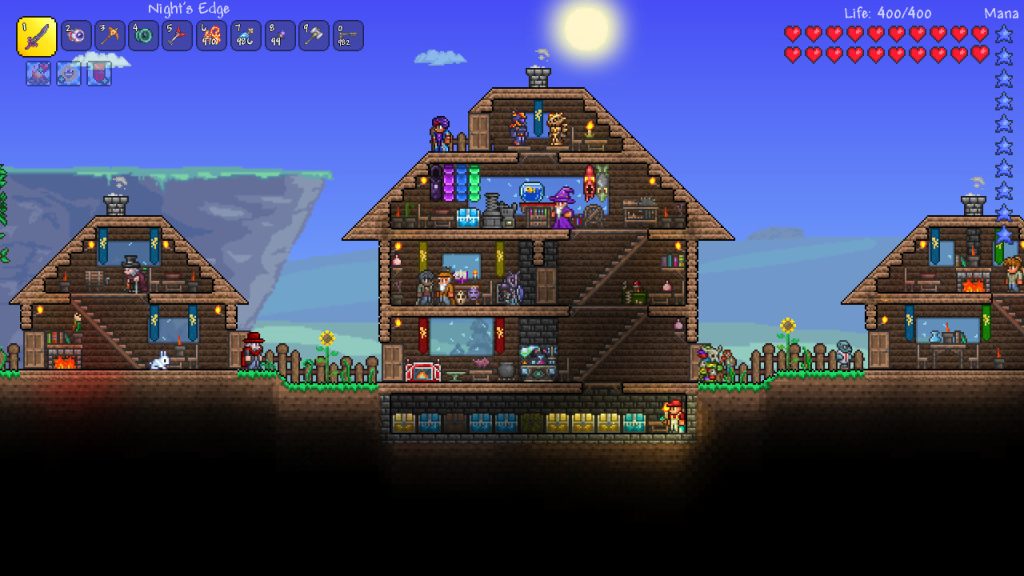
Quick answer: Enclose a room with blocks, cover the inside with background walls you place yourself, and add an entrance, a light source, a comfort item such as a chair, and a flat surface item such as a table. Then open the Housing menu from your inventory and query the room; it tells you immediately whether the room is valid and exactly what is missing. Natural background walls do not count, which is the mistake behind most rejected houses.
Housing looks like a building problem and is really a checklist problem. The game is unusually generous with what qualifies and unusually strict about one specific rule, so a house that looks perfect to a player can fail for a reason that is invisible until you ask the Housing menu.
The five things a house needs
A valid house has to satisfy every requirement at once. Miss one and the room is furniture, not housing.
| Requirement | What qualifies | Common mistake |
|---|---|---|
| Enclosure | Solid blocks forming a closed room with an entrance | Leaving a gap the game reads as open air |
| Background walls | Walls you placed yourself, covering the interior | Using the natural dirt walls already in the cave |
| Light source | Torches, candles, lamps, lanterns, a fireplace | Relying on daylight through a window |
| Comfort item | Chair, bench, bed, throne, or similar | Placing a table and forgetting the chair |
| Flat surface item | Table, work bench, dresser, bookcase | Placing a chair and forgetting the table |
An entrance is normally a door, though platforms placed in the wall generally serve the same purpose and are how most players build compact housing blocks. A trapdoor also works. What does not work is a room sealed completely, because there is no way in.
A bed is worth mentioning separately. It counts as the comfort item and lets you set your respawn point at that house, which means one piece of furniture satisfies two needs at once if you are short on materials.

The background wall rule, which catches everyone
This is the requirement that produces the most confused players. Terraria has two kinds of background wall: the natural walls generated with the world, and walls a player places from an inventory item. Only the second kind makes a room valid housing.
When you dig a room out of a hillside, the interior is already backed by natural dirt wall. It looks correct, it is the right shape, and it will never be valid housing. You have to place walls over the natural wall, which the game allows and which visually replaces it.
The practical fix is to carry a stack of any craftable wall while building. Wood walls are cheap and work fine. Place them across the full interior, including behind the floor and ceiling line, and the room flips from invalid to valid with no other changes.
Using the Housing menu instead of guessing
- Open your inventory.
- Click the housing icon to open the Housing menu.
- Use the query option and click inside the room you want to check.
- Read the result. It states whether the room is valid housing, and when it is not, it names what is missing.
- To assign a resident, select an NPC portrait in the menu and then click the room.
The query tool is the single most useful thing in this system. It converts a guessing game into a diagnosis, and it is the first thing to reach for whenever a house refuses to accept a resident.
Assignment matters too. A valid house is empty until you assign someone to it, and an NPC with no house assigned will wander rather than move in. If you have built housing and nobody arrived, check whether the rooms are actually assigned.
How big should a house be
The interior needs to be large enough to count, and the room has to be a genuine room rather than a cupboard. A commonly sufficient shape is a room roughly ten tiles wide and six tiles high inside, and anything larger is always safe.
Do not shrink rooms to fit more NPCs into a smaller footprint. Undersized rooms are rejected, and the failure looks identical to a missing piece of furniture, which sends players hunting for the wrong problem.
Build the shell first, then the internals. A row of identical rooms sharing walls is faster to build than separate huts, uses less material, and makes it obvious at a glance which rooms still need furniture.
Spacing, happiness and prices
Where you put houses is not purely aesthetic, because NPCs have preferences. Each NPC prefers certain biomes and reacts to how crowded their surroundings are, and those feelings affect the prices they charge you and what they are willing to sell.
The practical consequences are worth planning around. A handful of NPCs living together in a tidy block is convenient for you and mildly disliked by them. Spreading NPCs into small groups across different biomes keeps them happier, gets you better prices, and is also how you unlock pylon purchases in each biome.
The usual compromise is a compact housing block at your base for convenience plus a few two-resident outposts in biomes you visit often. Two residents per outpost is enough for a pylon and few enough to keep them content.
If a specific shop suddenly seems expensive or has stopped stocking something, moving that NPC to a preferred biome with fewer neighbours usually fixes it.
Building houses that survive Hardmode
Housing built in pre-Hardmode is often built cheaply, with wooden walls and a single door. That works until the world changes and enemies start walking through walls, at which point NPCs begin dying and your shops vanish one by one.
Two cheap precautions prevent most of it. Put the housing behind a solid outer wall rather than directly exposed to open ground, and keep the entrances away from where enemies path during events. A two-block-thick outer shell and a door set back from the main approach is enough for most of the game.
It also helps to build housing in more than one place. A single concentrated block is efficient until something gets into it, and then every NPC you rely on is in the same room.
Common problems and questions
The room is clearly fine but housing says it is invalid
Check the walls first. Natural walls, and any wall gaps behind the floor or corners, are the usual cause. Then confirm every tile of the interior is covered, not just the visible centre.
An NPC will not move into a valid house
Make sure the house is actually assigned to them in the Housing menu, and that they are not still waiting to be rescued or awoken elsewhere. Some NPCs only become available after specific events, so an unassigned room may simply have no candidate.
Can two NPCs share one house?
No. Each resident needs their own assigned house, which is why housing blocks are built as rows of separate rooms rather than one large hall.
Do I need furniture in the room or just nearby
Inside the room. Furniture placed outside the walls, or on the wrong side of a wall, does not count toward that room’s requirements.
Why did an NPC leave my base
If a house becomes invalid, for example because a wall was removed by an explosion or a segment was mined out, the resident loses their home and wanders. Repairing the room usually brings them back.
Build the shell, place walls, add a torch, a chair and a table, then query the room. Once you have done it twice, valid housing stops being a puzzle and becomes a five-minute routine you repeat without thinking.
Scope note
Written for the current PC version of Terraria. No external pages were fetched for this draft, so minimum interior size and happiness radius are given as guidance to confirm with the Housing menu rather than as exact figures.