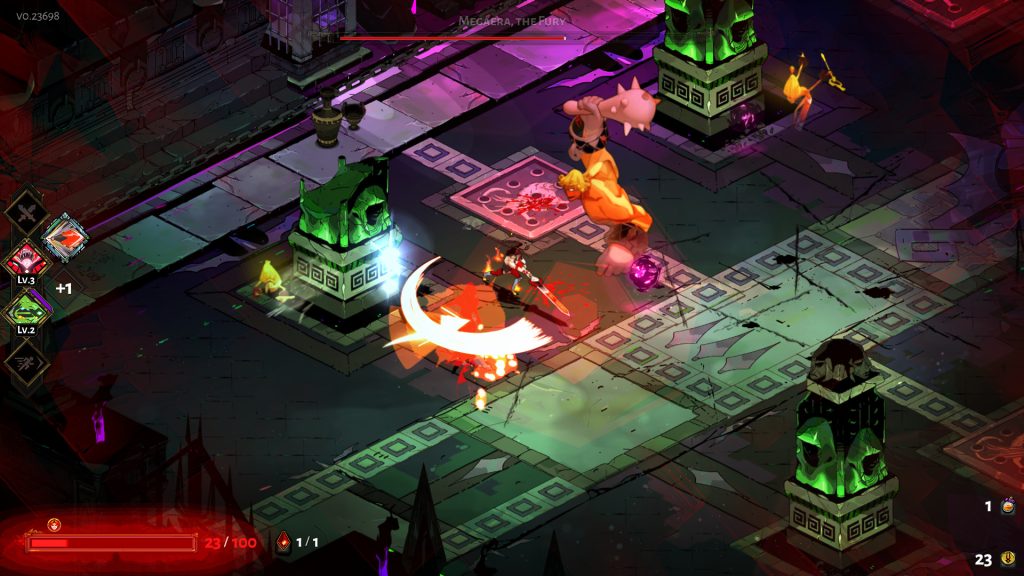
Hades Chaos Boons Explained
Quick answer: Chaos boons in Hades come from Chaos, the primordial god, and you reach them through Chaos Gates — portals that appear in some chambers. Entering a gate costs a chunk of your health, and the boon you receive there comes with a curse: a temporary penalty that lasts for a set number of encounters before expiring. In exchange you get effects stronger than most ordinary boons, which makes Chaos a calculated gamble rather than a free upgrade.
Chaos is the strangest god in Hades and the one players most often ignore, because the price is immediate and the reward is delayed. Once you understand the trade, Chaos becomes one of the most reliable ways to make a run stronger than its boon luck would otherwise allow.
Who is Chaos and why are their boons different?
Chaos is the primordial entity that predates the Olympians, and their boons sit outside the normal god system. You cannot get a Chaos boon from a standard boon reward, and no keepsake forces Chaos the way god keepsakes force Olympians — the route is the Chaos Gate, a portal that appears in place of or alongside other chamber features.
Because the access route is different, Chaos boons do not compete with your ordinary boon picks in the usual way. They are an extra layer you can opt into, not a replacement for the build you are assembling.

How do Chaos Gates work?
A Chaos Gate appears in some chambers as a distinct portal. Interacting with it costs health — a meaningful amount, not a token scratch — and takes you to a special chamber where Chaos offers a boon. You then return to your run and continue, with the boon active and its curse attached.
The health cost is the reason Chaos is a decision rather than an automatic yes. If you enter a gate at low health, you may simply die; if you enter early in a run when health is plentiful and healing is still ahead of you, the cost is trivial. Timing the gate is most of the skill involved.
What is the curse system?
Every Chaos boon comes with a downside that applies for a limited number of encounters — typically the next few chambers — and then expires. The curse might reduce your maximum health, weaken a specific attack, slow your movement, or make some other part of your kit worse. The buff, by contrast, is permanent for the rest of the run.
This is the core of the design: you accept a short, sharp penalty in exchange for a long-term gain. A curse that lasts a few chambers is survivable if you play carefully during those chambers; the buff then pays out for the remaining ten or fifteen.
The practical test is whether you can afford to be weaker right now. Taking a curse just before a boss is very different from taking one at the start of a region with several easy rooms ahead.
When are Chaos boons worth taking?
- Early in a run, when you have chambers to absorb the curse and plenty of health to pay the gate cost.
- When the buff addresses a real weakness — extra damage on your main attack, better boon rarity, or a resource gain you are short of.
- When you are already strong enough to survive the curse period without needing the stats it removes.
They are usually a bad idea immediately before a boss, at low health, or when the curse hits the exact mechanic your build depends on. Reading the curse text before accepting is not optional — the specific penalty matters far more than the headline buff.
How do Chaos boons compare to normal boons?
Chaos boons tend to offer effects that no Olympian provides: broad multipliers, unusual stat conversions, or resource generation. They are also rarer per run simply because gates are not guaranteed. The trade-off is that they do not contribute to Duo or Legendary boon requirements, which are built around specific Olympian combinations.
So Chaos boons are a supplement, not a substitute. They make a good build better; they do not assemble a build on their own.
Can you influence how often gates appear?
Chaos’s keepsake is the tool associated with the Chaos Gate system, and it is the closest thing to a reliable route into Chaos boons. Beyond that, gate appearances are a function of run randomness rather than something you can guarantee. If you are specifically building around Chaos, the keepsake is the pick; otherwise treat gates as a bonus when they show up.
Common mistakes with Chaos
- Entering a gate at low health and dying to the cost itself.
- Ignoring the curse text and taking a penalty that disables your main damage source.
- Taking a curse right before a boss instead of after it.
- Assuming Chaos replaces Olympian boons — it does not, and you still need normal gods for a coherent build.
FAQ
Does the health cost scale with anything? It costs a fixed portion of your health rather than being free at high health, so treat it as a real expense at any stage.
Do curses last the whole run? No. They expire after a set number of encounters.
Can I get multiple Chaos boons in one run? Yes, if multiple gates appear.
Do Chaos boons count toward Duo boons? No. Duo boons require specific Olympian pairs.
Is Chaos worth it on high heat? Often yes, since stronger boons matter more when margins are thin — but only if you can survive the curse window.
Next step
Chaos works best when your base build is already solid, so read our boon rarity explained guide to understand what you are supplementing, and the best keepsakes for beginners guide if you want to force a Chaos Gate on purpose.