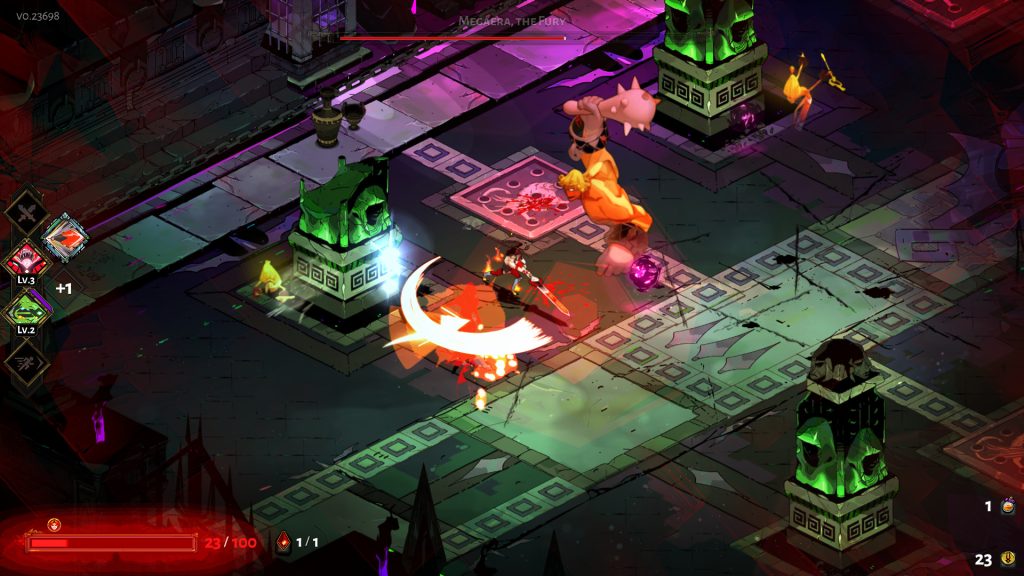
Quick answer: Heat is the total level of the Pact of Punishment, which unlocks after your first successful escape. Each condition you enable adds its level to your Heat, and the reward is bounties: the first time you clear a boss at a Heat level you have not beaten with that weapon, it pays out in upgrade currency — Titan Blood from the earliest boss and rarer currencies deeper in. So Heat is not a difficulty slider for its own sake; it is the game’s engine for farming Titan Blood, Diamonds and Ambrosia.
The system is easy to misunderstand, because raising Heat looks like voluntary suffering. It is actually the most efficient progression loop in the game once the story is finished: each new Heat level you clear with a weapon gives you a fresh set of boss bounties, and those bounties are the only renewable source of the rarest currencies.
How does Heat actually work?
The Pact of Punishment is a menu of optional difficulty conditions, each with a level you can raise. Your Heat for a run is simply the sum of the levels of everything you switched on. A run at Heat 4 might be one condition at 4, or four conditions at 1 each — the game does not care how you get there.
Because it is a sum, you can shape the difficulty to your weaknesses. That is the key insight: you are not picking “harder”, you are picking which kind of harder, and some kinds cost you far less than others.

What kinds of conditions are there?
| Category | What it does | Who it hurts |
|---|---|---|
| Enemy scaling | Enemies hit harder or have more health | Everyone, but especially melee builds with no health buffer |
| Economy pressure | Prices rise, or you lose resources on death | Players who rely on shop purchases mid-run |
| Run structure | Fewer choices, tighter time limits, forced chamber types | Players who build around specific boons |
| Enemy behaviour | More elites, more dangerous enemy variants | Players who clear rooms slowly |
| Boss changes | Extreme Measures rewrites boss fights | Anyone who has not mastered the base patterns |
The cheapest Heat for most players comes from economy and structure conditions that they can simply play around, and the most expensive comes from Extreme Measures, which invalidates learned patterns entirely.
How do bounties pay out?
Bounties are per-weapon and per-Heat-level. When you clear a boss at a Heat level you have not previously cleared with that weapon, that boss drops its bounty. Beat all four bosses at that Heat and you collect the full set for that level.
Two consequences follow. First, you should rotate weapons rather than grinding one: each weapon has its own bounty track, so the total available rewards multiply across six weapons. Second, you do not need to beat the final boss to profit — clearing the first boss at a new Heat level already pays, which means partial runs still advance your economy.
The Pact screen shows which Heat levels you have cleared with which weapon, and which bounties remain. That screen is the authority on your save, since the exact reward per boss differs by depth.
Why is Titan Blood the real target?
Titan Blood upgrades weapon aspects and unlocks hidden aspects, and it is the scarcest resource in the game. Its main renewable source is the earliest boss bounty — the Furies pay Titan Blood for Heat levels you have not cleared, which makes them the most farmed boss in the game by a wide margin.
Deeper bosses pay other currencies: Diamonds, Ambrosia and similar high-value materials. Those matter for the Wretched Broker trades and for relationship gifts, but if your goal is aspects, you want efficient early clears rather than deep runs.
What is the efficient way to farm Heat?
Pick the weapon you are most consistent with, set the lowest Heat level you have not yet cleared, and play for the first boss bounty rather than for a full clear. If the run is going badly, dying after the first bounty costs you very little.
- Rotate weapons so every bounty track advances.
- Prefer conditions you can ignore: economy and structure ones usually cost less than enemy scaling.
- Raise Heat one level at a time so each clear gives you a fresh bounty instead of jumping past several.
- Do not touch Extreme Measures until you are comfortable at that Heat without it.
- Take the bounty and leave if the run turns bad — a partial run still banks the boss you already beat.
Is there a cap?
Bounties run out. Each weapon has a maximum Heat level that still pays a bounty, after which clearing higher Heat is for pride rather than currency. When you reach that point across all weapons, your Titan Blood income shifts to prophecies and shop purchases, and Heat becomes a personal challenge rather than a farming method.
Practically, almost no player hits that ceiling before they have upgraded everything they want, so treat it as a distant limit rather than a planning constraint.
Does Heat affect the story?
No. Heat is post-first-clear content layered on top of the same runs. Story progression, dialogue and relationships advance identically whether you are at Heat 0 or Heat 20, although some character reactions may acknowledge your achievements.
Common questions
When does the Pact unlock? After your first successful escape. Before that, the option does not exist.
What is the easiest Heat condition? Usually an economy or structure condition you can play around, rather than anything that increases enemy damage. Test one at a time and see what your build tolerates.
Do I have to play at high Heat? No. It is optional progression for aspect upgrades and achievements, not a story requirement.
Why did I stop getting bounties? Either you have already cleared that Heat level with that weapon, or you have hit the bounty cap for it.
Should I raise Heat before or after unlocking hidden aspects? After. Titan Blood is better spent on the aspects you want first, and bounties are how you earn it — the two systems feed each other in that order.
Heat and aspect upgrades are the same economy: the hidden aspects guide explains what your Titan Blood is buying, and the final boss guide covers the fight that gates your first clear.