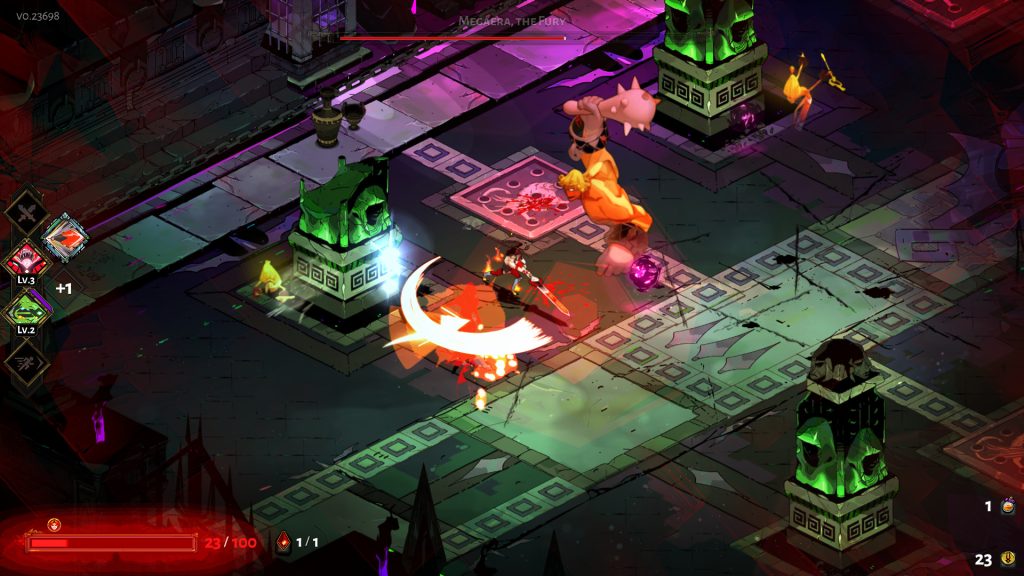
Quick answer: Hades is a two-phase endurance fight, and you beat it by budgeting, not by out-damaging it. Learn the handful of attacks he repeats, dodge through his lunges instead of away, and stop attacking during his vanish-and-slam. Then hold your Call, your burst and at least one Death Defiance for the second phase, where his tempo doubles and the same patterns arrive too fast to react to on autopilot.
This is the last door in the game and it is tuned accordingly. Players who lose here usually do not lose to a specific attack — they lose because they spent everything in phase one, or because they never learned to read the wind-up that precedes his biggest hit.
How is the fight structured?
Hades fights in two phases with a transition between them. The first phase is a readable duel: he closes distance, swings, and periodically leaves the ground to reposition. The second phase keeps the same vocabulary but speeds it up and layers additional attacks on top, so the fight becomes a test of whether your dodging is reflex or prediction.
There is no add phase to farm and no way to stall indefinitely. Damage taken in phase one is damage you do not have in phase two, which is why the correct strategy is conservative rather than aggressive.

Which attacks do you have to learn?
| Attack | Tell | Answer |
|---|---|---|
| Spear thrust | He steps in and draws back | Dash through him, then punish the recovery |
| Wide sweep | Long wind-up, wide arc around him | Get out of the arc, not away from him — the arc covers retreat |
| Vanish and slam | He disappears and the arena goes quiet | Keep moving in a wide circle; do not commit to an attack |
| Ranged pressure | He stops advancing and attacks from distance | Close the gap or use cover; do not stand and trade |
| Phase two combinations | Faster strings, less recovery | Take one hit per opening and reset |
The vanish is the attack that kills most runs, because it removes your target and tempts you into standing still. Treat the disappearance as a warning to reposition, never as a window to attack.
Why does dashing backwards lose the fight?
Hades’s attacks are designed to catch retreat. His thrust and sweep both cover the ground behind you, and the arena is bounded, so a backwards dash cycle ends with you pinned against an edge taking free hits.
Dashing through him puts you behind the swing and gives you the only reliable damage window in the fight. It also resets your position to the open middle of the arena, which is where you want to be when the next pattern starts.
How should you spend Calls, burst and revives?
Hold them for phase two. Phase one is survivable with basic attacks and patience, and every resource you save is a resource available when his tempo doubles.
On Death Defiance specifically: if you enter the fight with revives available, do not treat them as permission to trade hits in phase one. A revive spent at half of phase one is a revive you will want back ninety seconds later.
What should you bring into the fight?
Survivability first. A defensive dash boon, a health buffer and reliable healing matter more than a damage percentage, because the fight is long and every hit you avoid is worth more than the damage you add. Deflect is strong if projectiles are what catch you.
Ranged and cast builds have an easier time reading his patterns from distance, but they must still respect the vanish. Melee builds get better punish windows but take more chip damage, so they need the health buffer more.
Arena discipline. The final chamber is open rather than cluttered, and that shape is doing work for you: it means you can always circle, and circling is how you survive the vanish. Spend the fight moving around the perimeter rather than backing into a wall, and use the middle of the room to cross from one side to the other when he commits to a long animation.
Breakable props and healing pickups appear in the room, and the temptation is to grab them the moment you see them. Do not. Collect them during his recovery windows or between phases, because reaching for a health pickup during an active pattern is one of the most common deaths in the fight.
What changes on higher Heat?
The Pact of Punishment stacks on top of an already long fight, and Extreme Measures specifically rewrites boss encounters. Adding Heat conditions that increase enemy speed or damage turns the phase two overlap into something close to unreactable, so raise Heat gradually rather than jumping several levels at once.
If you are dying consistently at the last door, the answer is usually to lower Heat and rebuild the fundamentals, not to chase a stronger build.
What happens after you win?
The first clear is a story milestone, not the end of the game. The narrative continues across further escapes, and the Pact of Punishment becomes the main progression system afterwards. Your first win is the point where the game opens up rather than closes.
Common questions
How many phases does Hades have? Two, with a transition between them. The second is faster and adds attacks rather than replacing the first set.
Can I beat him without Death Defiance? Yes, but it requires near-perfect dodging in phase two. Treat revives as part of the plan rather than a failure state.
Is he the hardest boss in the game? He is the longest and the most punishing of mistakes. Theseus and Asterius are often harder on a first attempt because of the two-enemy pressure.
Should I use God Mode for this fight? That is a legitimate choice and it does not lock you out of content. See the God Mode guide if you want the details before deciding.
What is the best build for the final fight? One you can play while moving. High-damage builds that require standing still underperform here regardless of their numbers.
If you are still assembling the run that gets you here, the earlier fights are the real training: Theseus and Asterius teaches two-enemy discipline, and cast builds covers the ranged style that suits this arena.