Quick answer: Build a small connected road network, establish accessible homes and jobs, supply essential utilities, and expand in measured steps while checking demand, building warnings, traffic, and the current budget.

On this page
Cities: Skylines 2 beginner guide: establish a working district
Begin with a small city district that connects homes, workplaces, shops, and the outside road network. Supply essentials, inspect building warnings, and allow the simulation to show where people and companies settle. Add the next neighborhood after you understand the first one’s needs. A huge painted grid can create travel and service demands before you have the money or information to maintain it.
This guide uses the developer’s explanations of roads, zones, transport, traffic, and the economic model. Those feature articles describe the underlying systems, while later updates can change budgets, balance, and interface details. Use the current save’s displayed costs and warnings for financial decisions. The suggestions below are practical planning advice, not a tested fastest opening or a guaranteed profit formula.
| Early decision | Useful check | Reason to keep it modest |
|---|---|---|
| Road network | Outside access and a complete route | Avoid one overloaded entrance |
| Zoning | Demand, suitability, and available workers | Empty plots do not create a healthy economy |
| Utilities and services | Building warnings and operating status | Construction alone does not confirm service |
| Expansion | Budget and existing occupancy | New upkeep can arrive before new income |
| Transport | Actual destinations and line usage | Match investment to a working travel need |
1. Inspect the map before drawing the permanent center
Locate the outside roads, useful buildable terrain, water, and the space you want for later districts. Think about where homes and employment can connect without every trip crossing one short junction. You do not need a complete metropolitan master plan, but identifying a future main route can prevent a first neighborhood from blocking an obvious expansion corridor.
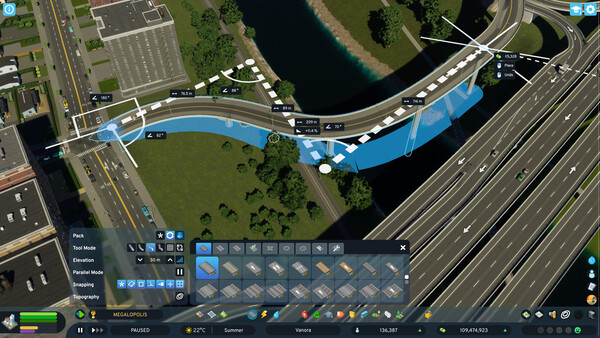
Start with roads you can afford to build and maintain. The road tools support grids, curves, parallel placement, elevation, and replacement, so the opening layout can evolve. A modest connected grid is easy to read, while curved roads can fit terrain. Choose from the site’s demands rather than assuming a decorative interchange or large avenue is necessary before the first residents arrive.
2. Build access that survives ordinary daily trips
Connect the initial district to the outside network and provide routes within it. Check actual road connections and direction after placing one-way segments or ramps. A road that appears close to another road can still leave a destination inaccessible if the connection or permitted direction is wrong. Follow a complete route from entrance to housing and from housing to employment.
Keep frequent local entrances away from the most important junction where practical. Shops, service vehicles, and delivery trips all use the network, so an attractive central crossing can become the collection point for several kinds of movement. Leave room to add an alternate connection or change a busy road after observing demand. Bigger roads are useful when they solve identified capacity needs; their width alone does not distribute destinations.
3. Supply essentials and read actual building status
Inspect electricity, water, and sewage information in the current interface as you establish the first homes and companies. Confirm that the required buildings or connections are operating and that the affected properties receive service. A completed utility asset can still need a valid connection, operating budget, or another missing part of its system. Read the warning on an actual unserved building to locate the problem.
Check the real construction and upkeep costs before adding large facilities. Early cash supports roads and services together, and future costs can remain after an immediate shortage is resolved. Use a modest working arrangement that fits the opening city, then expand capacity when the displayed need justifies it. Avoid copying old budget numbers from a different update and assuming they apply to your current economy.
4. Zone a useful mix around the first district
Residential demand concerns households seeking suitable homes. Employment sectors need workers, and commercial businesses need customers and goods. Place a manageable amount of housing with nearby opportunities for work and shopping, while keeping unsuitable pollution away from homes. Use the zoning suitability display instead of choosing plots only because they leave a neat rectangle on the map.
Commercial zoning works best where customers can reach it. Manufacturing needs access to resources, buyers, and workers, and office companies need a suitable workforce for their jobs. These zones have related demands rather than acting as independent colored bars to empty. If several buildings warn about missing workers or customers, adding more of the same type can enlarge the underlying mismatch.
5. Let occupancy and demand guide the next expansion
Read the detailed demand panel and inspect existing buildings. Empty homes, unavailable jobs, affordability, and workforce suitability can matter even when you want to build a specific skyline. Add the kind of space the city can use, then let the simulation respond. An unoccupied plot is potential capacity, not a resident or company that already pays income and uses services.
Residential densities also have different housing and affordability characteristics. Detached houses, row housing, apartment buildings, mixed housing, low-rent housing, and high-density towers serve different needs as they become available. Unlocking a dense option does not create demand for it at every location. Plan it near accessible destinations and inspect whether households actually move into the available buildings.

6. Add services for needs the city can maintain
When a service becomes available, inspect its purpose, coverage or capacity, road access, and current expense. A large facility can require more upkeep than the opening city comfortably supports. Prioritize a real shortage and make sure the service vehicles can reach the properties that need them. Physical closeness is less useful when the route is awkward or congested.
Give education time to affect the workforce. Companies need employees with suitable education levels, and different kinds of employment do not share identical requirements. A warning about educated workers is not instantly solved by painting another residential block. Check the population and available jobs together, improve the relevant services where practical, and avoid expanding demanding sectors faster than the labor supply develops.
7. Use budget information before committing to growth
Compare income with ongoing expenses and distinguish a construction purchase from recurring upkeep. Pause large expansion when the city already has capacity it cannot fill or facilities it cannot maintain. Use the current budget and the behavior of existing districts to decide what the next investment should accomplish. A rising population alone does not prove every new service or road is affordable.
Taxes can influence households and companies, but they are part of a wider economy involving rent, resource costs, workers, and connections. Change a setting with a clear purpose and observe demand and occupancy afterward. Raising every rate because the budget is uncomfortable can affect the people and businesses you need to develop. Do not rely on a universal tax percentage from another version or scenario.
8. Introduce public transport around a real corridor
Buses are a flexible early way to connect homes with jobs, shops, and service destinations. The network needs its depot, accessible stops, road connections, and an actual line. Choose one understandable route and inspect usage before covering the city in overlapping loops. A bus stuck in the same queue as private cars cannot magically remove that route’s road problem.
Later transport investments should match a need and the city’s means. Trams can use road tracks or dedicated routes; subways offer higher-capacity local travel with substantial infrastructure. Reserve promising corridors while the city is small, but build the larger system when its destinations and demand are clear. A station’s impressive size is not evidence that residents have a useful trip through it.
9. Diagnose one visible problem at a time
For a building warning, open the building and identify its actual need. For congestion, inspect the queue’s front and the destinations generating it. For weak growth, compare detailed demand with unused capacity and employment. Make one meaningful correction and allow the simulation to respond before changing several unrelated systems. This makes cause and effect easier to recognize.
Save before major road replacement or rezoning so you can review the consequences. A new avenue can alter building access, parking, and the zoning edge as well as capacity. Recheck utility status and neighboring warnings after redevelopment. A stable first city grows from maintaining complete daily systems, not from a single layout that eliminates every future issue.
Once the first district is running, use the traffic management guide when a recurring queue is the visible problem and the public transport guide when the road network needs a complete alternative to car trips. If growth rather than movement stalls, the zoning demand guide separates demand from an occupancy or access problem.
Frequently asked questions
Should I build a huge grid immediately?
Only if the city can support the cost and use the space. A smaller connected district is easier to supply and inspect. Leave expansion corridors and develop the next section when occupancy, jobs, and the budget support it.
Why does growth stop after I add more zoning?
New space may not match demand or the existing workforce, and buildings may lack access, customers, services, or affordability. Read the detailed demand and specific warnings. More empty plots do not directly fix those conditions.
Sources and scope
Sources read November 11, 2026. Mechanics come from the linked official overview and identified community references. Practical advice is editorial. No personal playtest, search-volume measurement, traffic result, or CMS score is claimed.