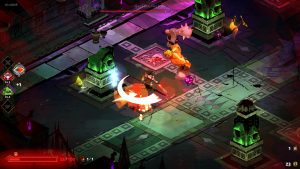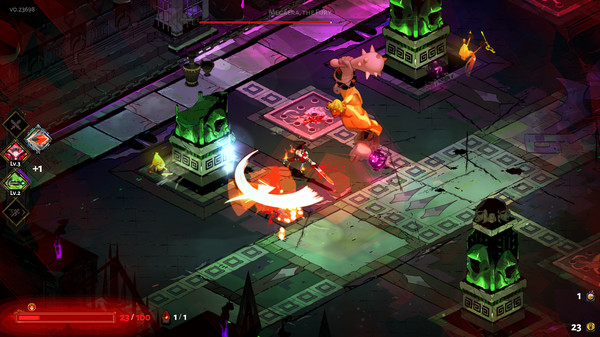
Quick answer: Unlock all six weapons and collect Titan Blood, then revisit the equipped weapon’s courtyard pedestal when aspects become available. Spend Blood on a form whose rule you understand.

On this page
Hades weapon aspects explained: forms are permanent choices
A weapon aspect is a saved form of an Infernal Arm. It can improve a particular action or substantially change the way the weapon works. Titan Blood unlocks and levels aspects, while Chthonic Keys unlock the base weapons. A Daedalus Hammer is a separate upgrade found during an escape. Start with the form’s actual rule, then decide whether your fighting style will use that rule often enough to justify an early investment.
In the original Hades, the arsenal contains six weapons and each has four aspects with five levels. The community reference says aspect access becomes available one run after the Rail has been unlocked and the player has collected at least one Titan Blood. If you have Blood but cannot use an aspect menu, verify those progression requirements first. This guide concerns Zagreus’ Infernal Arms; Hades II’s Nocturnal Arms and upgrade systems require their own instructions.
| System | Currency or condition | What changes |
|---|---|---|
| Base weapon unlock | Chthonic Keys | Access to the weapon |
| Aspect unlock or rank | Titan Blood | Permanent form or stronger aspect benefit |
| Daedalus Hammer | Found during current run | Temporary weapon modification |
| Hidden aspect reveal | Specific progress and dialogue | Reveals a form; purchase is separate |
| Aspect selection | Courtyard menu | Chooses the form for the next escape |
1. Unlock the basic arsenal before diagnosing the menu
The Stygian Blade is available at the start. The bow costs one Chthonic Key, the shield costs three, and the spear costs four. The fists cost eight after the first four weapons are unlocked. The rail costs another eight once the other weapons are unlocked. The full additional arsenal therefore requires 24 keys. This is base-weapon access, not a purchase of every aspect or an upgrade to its rank.
The sequence matters because aspects have an access condition tied to the completed arsenal and Titan Blood. Collecting one boss reward on a fresh save is not the whole condition. Continue ordinary attempts after the Rail unlock, then return to the courtyard. Use the equipped weapon’s pedestal interaction when the aspect menu is available. Read the selected form and rank before leaving; owning a form and actively using it are separate things, so a purchase alone does not prove the next run uses it.
2. Distinguish buying a form from leveling it
An aspect can be available in the menu but still require Blood to unlock or improve it. Read the current level and the displayed next benefit. A form’s defining mechanic and its rank-scaled number are related but not identical. For example, one aspect can establish a different attack relationship at an early level and then make that relationship stronger through later ranks. Compare what the next rank actually adds instead of treating every Blood purchase as an equally dramatic change.
Titan Blood investment is permanent in ordinary play, unlike the Mirror’s Darkness refund system. Make the first purchase deliberately. You do not need to max every form before testing a useful alternative, but spreading a small supply over many forms can leave all of them underdeveloped. A practical beginner approach is to learn the base weapon, select one appealing rule, and save toward that rule’s useful levels. That is a spending recommendation, not a claim that a universal best aspect exists for every player.
3. Use Zagreus aspects as understandable starting options
The first, Zagreus aspect of each weapon costs five Titan Blood in total to fully level, with one Blood per rank. These aspects often preserve the base weapon’s familiar structure while improving a straightforward property. For the Blade, Zagreus adds attack and movement speed. For the Bow, the Zagreus aspect adds critical chance to attack. Those are different effects, even though the forms share a character name and the same overall rank cost.
A familiar move set can make an early purchase easier to evaluate. Watch whether the benefit supports the actions you actually land in combat. Faster Blade movement does not turn it into a ranged weapon, and the Bow’s attack critical chance should not be assumed to apply identically to every special arrow. Read the exact scope. A low-cost aspect can be useful without being the final destination for your arsenal, especially while the main goal is a consistent first escape rather than an elaborate late-game build.
4. Understand the Blade’s alternative loops
The Blade’s Nemesis aspect gives attack a critical chance for three seconds after using special. That suggests a rhythm of special followed by attacks while the benefit is active. Simply selecting Nemesis and ignoring special misses the reason to use the form. Its rank improves the critical chance, so consider both your comfort with the sequence and the extra value of later levels before deciding how much Blood to invest.
Poseidon changes the Blade toward a cast relationship: its special dislodges cast ammunition from enemies and its aspect ranks increase cast damage. Use it when you want to cast, recover ammunition through special, and cast again. A player who only attacks may get little from that defining interaction. The hidden Arthur aspect has a distinct heavy move set, added health, and a defensive special aura, but it requires a separate reveal path. Do not assume Arthur is an ordinary unlocked menu choice just because a guide shows its picture.
5. Read the Bow’s targeting and cast differences
Chiron makes the Bow’s special seek the enemy last struck by attack. Its ranks increase the maximum number of special shots, with the referenced table progressing from four to eight. The defining sequence is therefore attack to establish the target, followed by special. That can be appealing if you want a clear target and a special-focused loop, but it still asks you to maintain positioning and avoid attacks while executing the sequence.
Hera loads cast ammunition into the next attack, releasing it on impact. Its rank-scaled property reduces the ammunition drop time. This is a different interaction from Chiron’s marked target and from the Zagreus attack critical bonus. Your cast selection and recovery plan matter. Do not copy a Chiron special build into Hera and expect the same result simply because both forms use the Bow. Rama is the hidden form with another move set and Shared Suffering mechanics; it is a later reveal project, not required to understand the ordinary Bow options.

6. Use the Shield’s form and defensive limits together
The Shield’s ordinary attack can block frontal damage while charging Bull Rush. That basic behavior is useful to learn before selecting an aspect that builds on a different part of its kit. The Chaos aspect and Zeus aspect change the relationship with special in different ways; inspect the current menu rather than treating every Shield form as a simple blocking upgrade. The useful question is what action follows your defense and where the special ends up.
The hidden Beowulf form changes the Shield’s play style further and has its own reveal requirements. A guide using Beowulf’s cast-flare terminology may not apply directly to your ordinary cast and selected Shield aspect. Keep the form names visible in your build notes. A new aspect does not remove the need to understand front-facing defense, nearby threats, and attack timing. For a beginner, a form whose sequence is understandable can be more valuable than a complex form whose theoretical strengths are never used.
7. Budget Blood by the actual aspect cost curve
The saved reference lists total full-level costs of five Blood for the first aspect, fifteen for the second, sixteen for the third, and fifteen for the hidden fourth. Those are complete aspect totals, not a single next-rank price. The Blade illustrates the curves: Nemesis uses one, two, three, four, and five Blood across its ranks, while Poseidon begins with two, two, then three, four, and five. Hidden Arthur uses three per rank.
Read the game’s displayed price before every purchase. A form that costs little to start can still need substantially more Blood to reach its top level. Reserve the amount needed for your next chosen benefit rather than spending because the inventory contains a spare unit. The full arsenal’s completion cost is a collection goal, not an early necessity. Titan Blood also has later cosmetic or ranking uses, but a player trying to improve escapes should consider weapon development before spending scarce early supplies on those purposes.
8. Treat hidden-aspect reveal as its own sequence
Every weapon has a hidden aspect that needs progress and a waking phrase from a particular character. Guan Yu on the spear is the first reveal in that chain. The reference requires reaching the final boss, owning the Fated List, and unlocking five non-Zagreus aspects, then receiving the relevant dialogue from Achilles. Reaching the final boss is not the same as defeating it, and revealing Guan Yu is not the same as buying or fully leveling it.
The other hidden forms require Guan Yu to be revealed, substantial Blood investment in the relevant weapon, and their own character interactions. Arthur’s example uses five Blood invested in Blade aspects and Nyx’s phrase. Other weapons can require a preliminary conversation while wielding the correct weapon. Dialogue queues can mean the relevant line does not appear on your next meeting. Continue legitimate conversations rather than repeatedly buying unrelated upgrades or looking for a field where you can type the waking phrase manually.
9. Test the selected form with ordinary expectations
In the courtyard, read the form’s rule and practice the required sequence against the training target. Then choose a run whose boons support that sequence. If the form depends on special, make special part of your actual rhythm. If it depends on cast recovery, choose and manage a cast that works with the interaction. A strong aspect description cannot help if the main action in your run never triggers the benefit.
After the attempt, judge the form by a concrete observation: did you remember its sequence, did it fit your preferred distance, and did your chosen boons support it? Do not blame the aspect only because an unfamiliar boss ended the run. Enemy knowledge and health management still matter. A reasonable investment plan can evolve as you learn, but each Blood purchase should have a reason. Keep temporary Hammer choices separate in your notes so you do not attribute a run-specific change to the permanent form.
Questions about aspects
Why do I have Titan Blood without an aspect menu?
Check the completed basic arsenal and the additional attempt after unlocking the Rail. Blood ownership by itself is not the whole access condition. Return to the equipped weapon’s pedestal when the system becomes available, and inspect the actual form menu.
Can I refund an aspect like a Mirror talent?
Do not plan on an ordinary Titan Blood refund. Mirror Darkness redistribution is a separate system with a key cost. Decide on aspect spending before confirming it, using the displayed benefit and price rather than assuming the currency can be freely moved between forms.
Do I need hidden aspects for a first escape?
No. Ordinary weapon forms and a functional set of boons can support the game without completing every reveal. Hidden aspects are additional play styles with their own conditions. Learn the weapons you have instead of making a late unlock the prerequisite for basic progress.
Sources and scope
Sources read November 11, 2026. The guide describes the original game using official information and identified community mechanics references. Practical recommendations are editorial. No personal playtest, measured search demand, traffic result, or CMS score is claimed.