TL;DR: Read the recipe and kitchen layout, give each player an initial job, and serve the visible order queue deliberately. Throw raw ingredients when it saves a trip, keep plates and pans circulating, and change roles when moving counters split the team. Repeat an early kitchen to improve one problem before pursuing every high score.
These Overcooked 2 beginner tips cover Overcooked! 2 itself. Overcooked! All You Can Eat is a separate collection with its own feature set. Team17 also now lists a Nintendo Switch 2 edition, so check the exact product in your library before following platform-specific setup advice.

On this page
Overcooked 2 Beginner Tips: Make a Plan Before Moving
At the beginning of a kitchen, identify the ingredient supply, chopping boards, cookers, serving hatch and washing area. Then read the first orders. Running toward the nearest onion is less useful than knowing whether the current recipe needs that onion at all.
Agree on simple job descriptions. One person can prepare ingredients, another cook and plate, and another serve or wash when the kitchen supports it. These jobs are a starting arrangement rather than a promise that each person must ignore everything outside their station.
Say what you need in concrete terms: one chopped tomato, a clean plate or help with the next pot. A short request is easier to act on than several people shouting the names of every ingredient on the screen.
1. Read Orders Before Preparing Large Batches
The order queue tells you what the kitchen currently needs. Prepare the next useful dish instead of making whichever recipe you remember most clearly. Extra chopped ingredients are helpful only when they match upcoming orders and do not occupy every counter.
Use completed dishes carefully. Serving the wrong dish or working far ahead while an earlier order expires can reduce the value of the team’s effort. Keep someone watching the queue, especially when the others are focused on timing a cooker or crossing a moving route.
When the team becomes overwhelmed, identify the oldest practical order and finish it together. Recovering one clear objective is often easier than continuing four half-finished recipes while every counter becomes congested.
2. Divide Work by Geography
The kitchen layout often matters more than a fixed job title. A player standing next to chopping boards can prepare ingredients while a teammate near the cooker handles heating. Passing items between nearby stations avoids several people competing for the same narrow path.
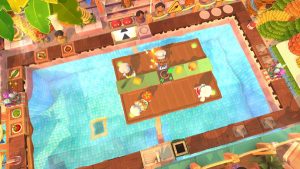
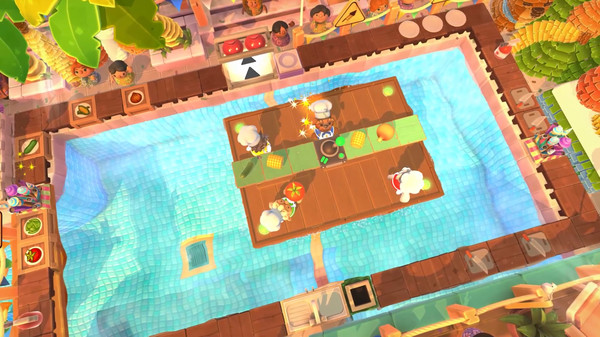
In a kitchen with moving platforms or separated counters, roles need to follow the accessible equipment. If the serving side is briefly isolated, prepare what can be passed over rather than asking that player to cross a route that is unavailable.
With two players, each person will usually combine several jobs. Keep the division simple enough to remember under pressure. With a larger group, avoid assigning everyone to chopping while nobody watches cooked food or returns plates.
3. Throw Raw Ingredients to Save Travel
Throwing is a defining addition in Overcooked! 2. The publisher describes tossing ingredients across the kitchen and directly into pans. Use it to move raw ingredients across a gap or toward the preparation area without carrying each item along the full walking route.
Choose a clear landing point and warn the receiver. An ingredient thrown to an empty useful counter saves time; one thrown into a crowded pile can merely move the mess. Practice the direction and distance during a low-pressure stage before making every delivery a throw.
Do not treat the throw button as a universal way to transport every object. Plates and finished dishes need their appropriate handling. Identify what you are holding before attempting a shortcut that the object does not support.
4. Keep Plates Returning to the Kitchen
A supply of ingredients does not help if nobody has a usable plate. Where a stage returns dirty plates and provides a sink, assign washing and plate recovery as a real job. Waiting until every dish is ready can reveal that the team has no clean surface to serve it on.
Keep a clean plate near the area where finished food emerges. That reduces the distance between finishing a recipe and sending it to the serving hatch. Avoid filling the most useful plating counter with raw ingredients that could sit somewhere less central.
After serving, check what needs to circulate back: dishes, cooking containers and the next ingredient. A kitchen runs as a loop. Treating service as the end of every task can leave the next order waiting for equipment the team forgot to return.
5. Watch Cooking While Doing Other Work
Start a cooker when the required ingredients are ready, then use its cooking interval for another nearby task. Chopping, washing or preparing the next plate can make that interval productive. Stay aware of the cooker so the extra task does not become an unattended-food problem.
Call out which container is about to finish if another player is closer to it. The best person to act is often the one already standing beside the equipment. Teamwork includes handing off a small action when travel would waste more time than the action itself.
If a fire starts, use the extinguisher and restore the station before returning to ordinary cooking. Simply adding another ingredient does not repair a burning work area. Once safe, rebuild the next necessary recipe rather than panicking through unrelated tasks.

6. Use Shared Counters as Deliberate Handoffs
Choose one or two counters for passing items between roles. That lets the receiver know where a chopped ingredient or prepared dish will appear. Leaving items everywhere forces teammates to search while the timer continues.
Keep the handoff area clear enough to read. If every square holds a different ingredient, announce what is ready and move unnecessary stock aside. Counter space is a resource alongside time, ingredients and plates.
7. Adapt When the Level Changes
Team17 describes kitchens on moving vehicles and other changing environments. Watch how the layout alters your route. A division of jobs that worked before a shift may become inefficient afterward.
Change the nearest useful task instead of fighting to maintain an old position. A person suddenly beside the serving hatch can serve, while the teammate now beside ingredients prepares them. Announce the switch so both players do not assume the other still handles the previous role.
8. Prefer Controlled Movement in Crowded Areas
Fast movement helps across an open route but can create collisions in narrow spaces. Look ahead before rushing through a teammate’s working area. A small detour is worthwhile if the direct route repeatedly knocks the team out of its rhythm.
Use short movement bursts around counters and hazards. Losing an item or needing to recover position can cost more time than the shortcut saved. Improve the route first, then increase speed when you can perform it consistently.
9. Replay One Kitchen with One Improvement
After a failed or low-scoring attempt, name the main bottleneck. Perhaps orders were prepared out of sequence, plates stayed dirty or both players kept crossing the same bridge. Choose one change for the next attempt so you can tell whether it helped.
Do not demand a perfect run while everyone is still learning the recipe. A familiar early kitchen is useful practice for job changes and throwing. A clear improvement is a better learning target than treating every result below the top rating as wasted time.
10. Check Multiplayer Setup Before the Shared Session
Overcooked! 2 supports local and online co-op for up to four players. Confirm the edition and platform arrangement before inviting friends. Our online co-op setup guide and crossplay explanation address those separate questions.
For a small free window, choose a known kitchen and agree on the final attempt. The game can suit short co-op sessions, but setup and repeated retries still consume time.
Frequently Asked Questions
Should every player keep the same job?
No. Start with clear jobs, then adapt to the layout, order queue and changing access. Fixed roles help communication only while they help the kitchen.
Why do we have food ready but few completed orders?
Check plates, the serving route and order sequence. Ingredients are only one part of the loop; washing and delivering need active attention too.
Can Overcooked! 2 be played by two people?
Yes. Its cooperative modes support up to four players, and two players can divide the kitchen between them. Each will usually perform more than one job.
Next step: Replay a familiar stage with a clear plate routine and one planned handoff counter. Once the team can keep those working, add faster ingredient throws and more ambitious score attempts.
Sources and Version Notes
Sources read November 11, 2026. Platform features refer to the named edition; this is source-backed guidance, not a personal playtest.