TL;DR: Search deep underground beneath mountain terrain, look for the deep dark, and inspect around Y=-51 for large deepslate corridors and ruins. Bring wool, food, lighting, and a clear route back to safety. Finding sculk does not guarantee an ancient city, and finding a city does not require fighting a warden.
This Minecraft how to find an ancient city guide recommends searching deep dark beneath mountains and checking the city-floor height of Y=-51. That is a useful search plan, not a guaranteed coordinate for your seed. If commands are permitted, locate can identify a structure directly, but you still need to plan a safe arrival.
Ancient cities are large underground structures introduced with the Wild Update. Their sculk, shriekers, and darkness make a rushed first visit dangerous, so separate the search from a full looting expedition.

On this page
Minecraft How to Find an Ancient City: Prepare Before Descending
Carry wool blocks, ordinary building blocks, food, lighting, a pickaxe, and equipment you are prepared to risk. Wool helps create quieter routes and block some vibration paths. It does not make every action safe, and good armor does not make a warden a normal cave fight.
Record your starting coordinates and leave supplies near the surface entrance. An emergency kit is most useful when it is outside the dangerous area. A chest full of replacement tools deep inside the city is harder to reach after a failed first visit.
1. Choose Mountain Terrain as a Search Area
The official ancient-city guide recommends looking beneath mountainous biomes such as jagged peaks and snowy slopes. The deep dark favors underlying terrain conditions associated with low erosion. A mountain is therefore a practical clue for choosing a search area, not proof of a city directly under the summit.
Pick an area you can reach repeatedly and mark the entrance. If one explored mountain produces no city, move to another sector rather than assuming you missed a guaranteed structure. Different seeds and terrain conditions produce different results.
On an older world, prioritize terrain generated under a release that includes ancient cities. An update does not simply replace every previously explored cave with a new structure. The history of the searched chunks matters.
2. Descend with a Staircase or a Safe Cave Route
Dig a staircase or use a cave descent that you can climb back out of. Never dig straight down in hopes of landing on a city floor. Ancient cities occupy large caverns, so breaking through a ceiling can lead to a long fall before you even see the structure.
Check the vertical coordinate frequently. Java’s debug screen shows player coordinates; Bedrock can show them through the world setting. Aim to explore the deep region around Y=-51, the documented city-floor level, without treating every nearby tunnel as a guaranteed entrance.
Light and mark the safe approach while you descend. If the route becomes complicated, note intermediate coordinates or use consistent markers. Returning through ordinary caves is easier when you established those clues before the deep-dark portion begins.
3. Recognize Deep Dark and City Architecture
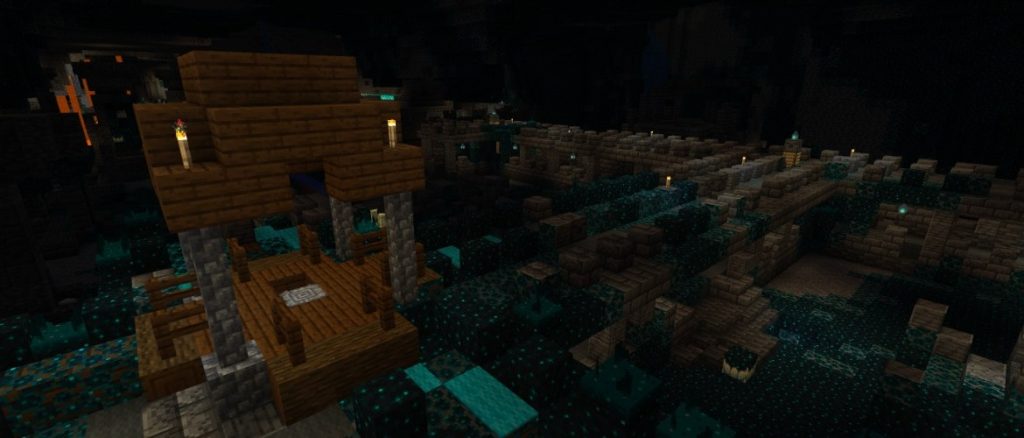
Sculk-covered surfaces, sensors, and shriekers tell you that you have reached the relevant biome. They do not prove a city exists in that particular patch. Inspect nearby caverns carefully while remaining aware of vibration-sensitive blocks.
An ancient city has intentional architecture: long deepslate corridors, ruins, towers, wool-covered routes, and a large central frame. The size and repeated construction patterns distinguish it from an ordinary sculk-covered cave. Look for multiple connected structures rather than identifying one dark block as the whole city.
If the cavern ends without a city, search a different part of the deep-dark area or return to a new mountain sector. A marked list of searched entrances is more useful than repeatedly circling the first sculk patch you found.

4. Establish a Quiet Route and Retreat Point
Before opening chests, choose a route back to the entry tunnel. Inspect where the sensors and shriekers sit, then use available wool paths or add wool where it helps reduce movement vibrations. Keep a clear exit that does not depend on crossing an exposed drop.
Sneaking reduces certain movement vibrations, but does not silence every interaction. Opening a chest, placing or breaking blocks, and other actions can still matter. Pause to inspect the surroundings before interacting rather than assuming the sneak key gives permanent immunity.
Torches help you see, but lighting does not disable the special shrieker mechanism. Do not treat the city as an ordinary dark room that becomes harmless once lit. Wool and careful movement address different risks from illumination.
5. Loot a Small Area and Leave Before the Risk Escalates
Begin with a few reachable ruins near the safe route. Ancient-city loot can include echo shards and other distinctive rewards, but no individual chest guarantees the item you wanted. Take useful finds home rather than exploring the entire structure in one trip.
Repeated activations of naturally generated shriekers can summon a warden. The warning level belongs to the player across shriekers; moving to a different shrieker does not provide a completely fresh warning allowance. Treat any escalation as a reason to slow down and reconsider the route.
If a warden appears, prioritize creating distance and leaving safely. It is blind, but can use sound and smell, so sneaking nearby is not perfect protection. Its sonic attack can pass through blocks and bypass ordinary armor or shield protection; hiding behind a thin wall is not a reliable combat plan.
Store recovered valuables outside the city before the next visit. You can then return with a specific goal and a better understanding of the layout. The first successful expedition should end with supplies safely home, not with a fight taken solely because your armor is expensive.
6. Use Locate or a Seed Aid Only When Allowed
If your world permits modern locate commands, Java uses /locate structure minecraft:ancient_city, while corresponding Bedrock releases use /locate structure ancientcity. Use command autocomplete to confirm the name and syntax for your installed release.
A located coordinate identifies the target, not a safe landing surface. Travel through a controlled route rather than blindly placing yourself at a guessed vertical coordinate. On servers, world permissions and exploration rules may restrict commands or access to the seed.
Seed-based aids must match the edition, release, and generation settings to be useful. A result for another edition or an old generation version can mislead you. If a particular release offers an explorer-map route, check that release’s acquisition rules instead of assuming every old guide or current world has the same map option.
Frequently Asked Questions
Does every deep-dark biome have an ancient city?
No. The deep dark is the biome where cities generate, but sculk alone does not guarantee a city in that patch. Search surrounding caverns or another suitable terrain sector.
What Y level should I search?
The documented ancient-city floor is Y=-51. Use that as a useful exploration height while checking nearby cavern space, not as a guarantee of a structure at your current X and Z coordinates.
Can wool stop every sensor activation?
No. Wool helps with quieter movement and vibration occlusion, but placement and the action involved still matter. Inspect sensors and shriekers before interacting with nearby chests or blocks.
Should I kill the warden before looting?
No. Fighting it is not required to obtain city loot. It has dangerous attacks and is designed as a major threat; a careful route and an early retreat are more practical for a first visit.
Next step: Pick a mountain search area, record the entrance, and descend with wool and a retreat plan. For preparation, read the enchantment order guide or the diamond mining guide, then return to the Minecraft hub.
Sources and Version Notes
- Minecraft: Building Blocks, Ancient City, official 2025 mountain-search and safety advice.
- Minecraft: Around the Block, Deep Dark, official biome and vibration context.
- Minecraft Wiki: Ancient City, city floor and structure details; readable source reviewed November 10, 2026.
- Minecraft Wiki: Warden, player warning and attack mechanics; community-maintained.
No fixed search radius, seed coordinate, chest reward, or explorer-map availability is promised for every release.